







Why Dark Circles and Under-Eye Aging Are Harder to Treat Than You Think
PRP injection under the eyes is a natural, non-surgical option for addressing dark circles, hollow tear troughs, and thinning under-eye skin. If you’re trying to decide whether it’s right for you, here’s a quick overview:
What under-eye PRP may help with:
- Dark circles caused by thin skin and visible blood vessels
- Hollow or sunken tear troughs
- Fine lines and crepey skin texture
- Loss of firmness and elasticity in the lower eyelid area
How it works:
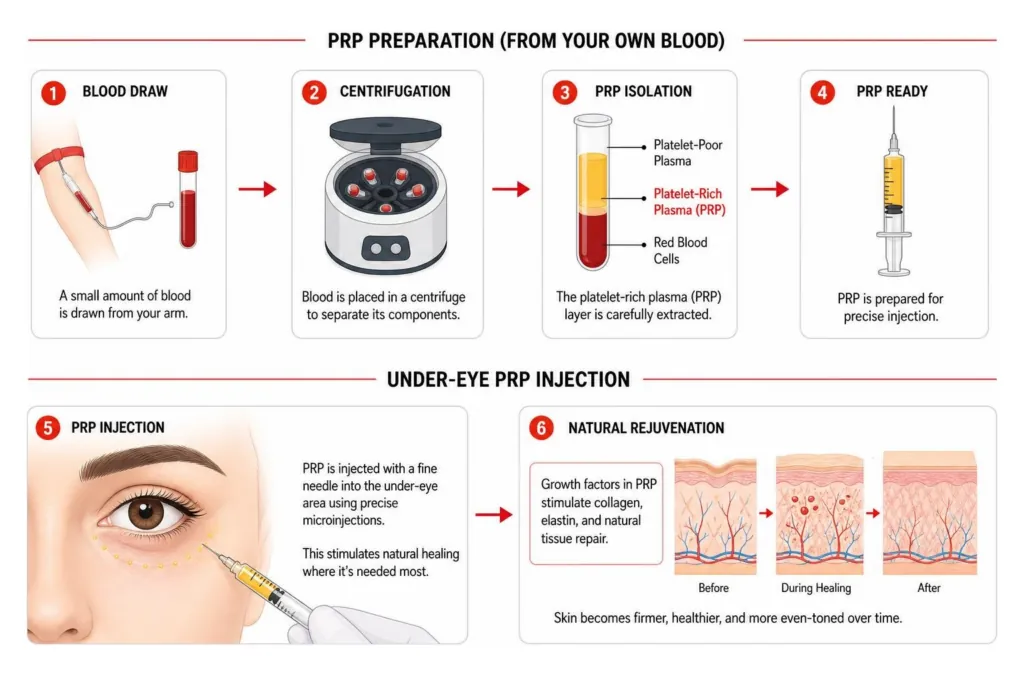
- A small amount of blood is drawn from your arm
- It’s spun in a centrifuge to concentrate the platelets
- The platelet-rich plasma is injected into the under-eye area
- Growth factors stimulate collagen, elastin, and natural tissue repair
What to expect:
- Results begin within 2–4 weeks
- Full improvement develops over 2–3 months
- A series of 2–3 sessions spaced 4–6 weeks apart is typical
- Results vary, and maintenance sessions are usually needed
The skin under your eyes is among the thinnest on your entire body — and it shows aging earlier than almost anywhere else. Dark circles, puffiness, and hollowing can make you look tired or older, even when you feel perfectly fine. Many people try creams and home remedies for years with little to show for it.
That’s because surface-level treatments can’t reach the root cause: collagen loss, reduced skin thickness, and poor microcirculation in the deep layers of the skin. PRP works differently. It uses your body’s own healing biology to rebuild from the inside out — no foreign substances, no surgery, no dramatic downtime.
I’m Anna Slavin, Practice Manager at Global Clinic, where our practitioners bring over 20 years of experience in the US and Europe and our team offers regenerative treatments for skin rejuvenation, including under-eye PRP. In the sections below, I’ll walk you through exactly how PRP works for the under-eye area, what the science says, and how to know if it’s the right fit for you.
The Science of Platelet-Rich Plasma and Under-Eye Rejuvenation
To understand why under-eye PRP can be effective, we have to look at the cellular level. Platelet-rich plasma is an autologous treatment, meaning it is derived entirely from your own blood. Your blood is primarily made up of red blood cells, white blood cells, plasma, and platelets. While we often think of platelets solely for their clotting abilities, they are actually packed with proteins called growth factors.
These growth factors—including Platelet-Derived Growth Factor (PDGF), Transforming Growth Factor-Beta (TGF-β), and Vascular Endothelial Growth Factor (VEGF)—serve as chemical messengers. When injected into targeted tissues, they trigger a cascade of natural healing processes. They stimulate fibroblasts, which are the builder cells responsible for producing collagen and elastin.
In the delicate lower eyelid region, chronological aging and sun damage (known as actinic elastosis) lead to a breakdown of these structural proteins. UV radiation actively inhibits the pathways that promote collagen production. This results in crepey skin, fine lines, and a loss of skin thickness. Because the skin becomes so thin, the underlying muscle and blood vessels show through, creating the appearance of dark circles.
A scientific research study on PRP for lower eyelid rejuvenation published in the PMC database evaluated the efficacy of PRP for treating these exact issues. Researchers utilized objective skin measurement tools, specifically a cutometer, to track changes in skin firmness (R0 values) and elasticity (F0 and F1 values). The results were statistically significant:
- Skin firmness values improved significantly.
- Skin elasticity parameters showed highly significant recovery.
- Collagen optical density in the skin improved by over 89% in the PRP treatment group compared to only 46% in the control group.
By delivering a concentrated dose of growth factors directly to the area, PRP stimulates fibroblasts to increase the secretion of both type I procollagen and endogenous hyaluronic acid. This may help improve the skin’s natural architecture in ways that topical treatments cannot. To learn more about how this technology is used across regenerative medicine, explore our comprehensive guide on platelet-rich plasma.
Rejuvenating the Periorbital Region with PRP
Injecting the periorbital (around-the-eye) region requires a highly specialized approach. Because the skin here is incredibly thin and lacks a substantial underlying fat layer, traditional treatments can sometimes look artificial or lumpy. Under-eye PRP offers a natural alternative.
Rather than simply filling a hollow space with a synthetic gel, PRP improves the actual quality, thickness, and microcirculation of the skin. By promoting the formation of new micro-capillaries (neovascularization), PRP enhances local blood flow. Over a treatment series, healthier, thicker skin can help mask the dark tissues beneath.
Many patients choose to combine under-eye injections with broader facial treatments. Performing a platelet plasma facial alongside targeted under-eye injections allows for comprehensive facial rejuvenation, addressing overall skin texture, tone, and fine lines simultaneously.
What to Expect During Your Under-Eye PRP Procedure
If you are considering this treatment, knowing what to expect can help ease any anxiety. The entire procedure is straightforward and typically takes about 45 to 60 minutes:
- The Blood Draw: We begin by drawing a small sample of blood (usually between 10 to 60 ml) from your arm, similar to a routine lab test.
- Centrifugation: The blood sample is placed in a specialized centrifuge. It is spun at high speeds for about 5 to 15 minutes to separate the golden platelet-rich plasma from the red and white blood cells. For periorbital treatments, we often use a double-centrifugation process to achieve an optimal platelet concentration of approximately 2.5 times your baseline.
- Numbing: While your blood is processing, a medical-grade topical numbing cream is applied to the under-eye area for about 20 minutes to ensure your comfort.
- The Injections: Using a very fine needle or a specialized microcannula, the golden PRP is carefully injected along the tear troughs and the crepey skin of the lower eyelid. Techniques like linear threading or a fan pattern are used to distribute the plasma evenly.
Most patients report only mild discomfort—often described as a brief, warm stinging sensation or a feeling of pressure. This temporary sting is actually due to the natural, slightly acidic pH of the concentrated plasma rather than the needle itself. For a detailed breakdown of the preparation and safety standards, read our guide on understanding PRP injections: benefits, risks, and what to expect.
Who Is a Good Candidate for Under-Eye PRP?
PRP can be a good option for many patients, but it is particularly beneficial for those experiencing:
- Crepey, thin skin under the eyes
- Mild to moderate dark circles (especially those of vascular origin)
- Early stages of under-eye hollowing or tear trough volume loss
- Fine lines and “crow’s feet” around the periorbital region
Because PRP is autologous, the risk of allergic reaction or rejection is very low, which can make it a good option for sensitive patients.
However, PRP may not be suitable for everyone. Individuals with active skin infections in the eye area, severe volume loss (which may require structural filler or surgical intervention), or those on blood-thinning medications should proceed with caution. Furthermore, patients with underlying platelet disorders, active cancers, or a heavy smoking history may not achieve optimal results, as these factors can impair platelet function and the body’s natural healing response.
Comparing Under-Eye PRP to Alternative Approaches
When exploring options for under-eye rejuvenation, it helps to understand how PRP stacks up against other popular clinical treatments.
| Treatment Type | Primary Mechanism | Best For | Results Timeline | Longevity |
|---|---|---|---|---|
| PRP Injection | Natural growth factors stimulate collagen & microcirculation | Thin, crepey skin, dark circles, mild hollowing | Gradual (2–3 months) | Often 12 months or longer; varies |
| Dermal Fillers | Hyaluronic acid gel physically adds volume | Deep tear trough hollowing, structural volume loss | Immediate | 6 to 12 months |
| Botox / Neurotoxins | Temporarily relaxes underlying muscles | Crow’s feet, dynamic wrinkles | 3 to 7 days | 3 to 4 months |
| Microneedling | Controlled micro-injuries trigger collagen production | Surface texture, fine lines, skin elasticity | Gradual (1–2 months) | Cumulative / Varies |
While dermal fillers are excellent for instantly masking deep hollows, they carry specific risks in the delicate under-eye area. If injected too superficially, fillers can cause the “Tyndall effect” (a bluish discoloration of the skin) or lead to localized lymphatic obstruction, resulting in chronic puffiness.
PRP, on the other hand, does not add immediate synthetic volume. Instead, it focuses on long-term skin health. It may thicken the skin naturally, improve tissue quality, and restores a youthful bounce without altering your natural facial structure.
Frequently Asked Questions About Under-Eye PRP
How many sessions are typically required for optimal results?
For the majority of patients, we recommend an initial series of 2 to 3 treatment sessions spaced 4 to 6 weeks apart. Because PRP relies on your body’s natural cellular remodeling, the effects are cumulative. While you may notice subtle brightness and improved hydration within a few weeks of your first session, the peak of collagen synthesis and tissue remodeling occurs around 2 to 3 months after your final treatment. To maintain these regenerative results, a single maintenance session is typically recommended every 6 to 12 months.
What is the recovery time and downtime?
One of the benefits of under-eye PRP is minimal social downtime. Immediately following the procedure, you will experience temporary swelling and redness, which is a normal inflammatory response to the active growth factors. Some patients experience mild bruising or a feeling of fullness under the eyes that typically resolves within 2 to 5 days.
To ensure optimal healing, we advise patients to avoid rubbing or massaging the injection site for at least 24 hours, skip strenuous exercise for 48 hours, and sleep with their head slightly elevated on the first night.
Are there any serious risks associated with facial PRP?
Because PRP utilizes your own blood, classic risks like allergic reactions, infections, or foreign-body rejection are exceptionally rare. However, any injection in the facial region requires a profound, expert understanding of vascular anatomy.
The facial and ophthalmic arterial networks are highly interconnected. Inexperienced injectors performing high-pressure injections in high-risk areas (such as the glabella or tear troughs) run a rare but serious risk of intravascular injection, which can lead to localized skin necrosis or retrograde embolization. This is why it is absolutely vital to have your treatment performed by board-certified medical professionals in a clinical environment.
Conclusion
Rejuvenating the delicate under-eye area requires a delicate balance of medical expertise and advanced regenerative science. At Global Clinic, we deliver personalized, state-of-the-art care to our communities across Northern Chicago. Whether you visit us from Niles, IL, Skokie, IL, Glenview, IL, Park Ridge, IL, Morton Grove, IL, Des Plaines, IL, or Mount Prospect, IL, our multidisciplinary team is dedicated to helping you look and feel your absolute best.
If you are ready to address tired-looking eyes, dark circles, or crepey skin with a natural, evidence-based approach, we are here to guide you every step of the way. Call our Niles clinic at (847) 299-7000 to schedule an appointment for PRP injections and take the first step toward restoring your natural, youthful glow.