








What “Chiropractor Meaning” Actually Tells You About This Type of Care
Understanding the chiropractor meaning is simpler than most people expect.
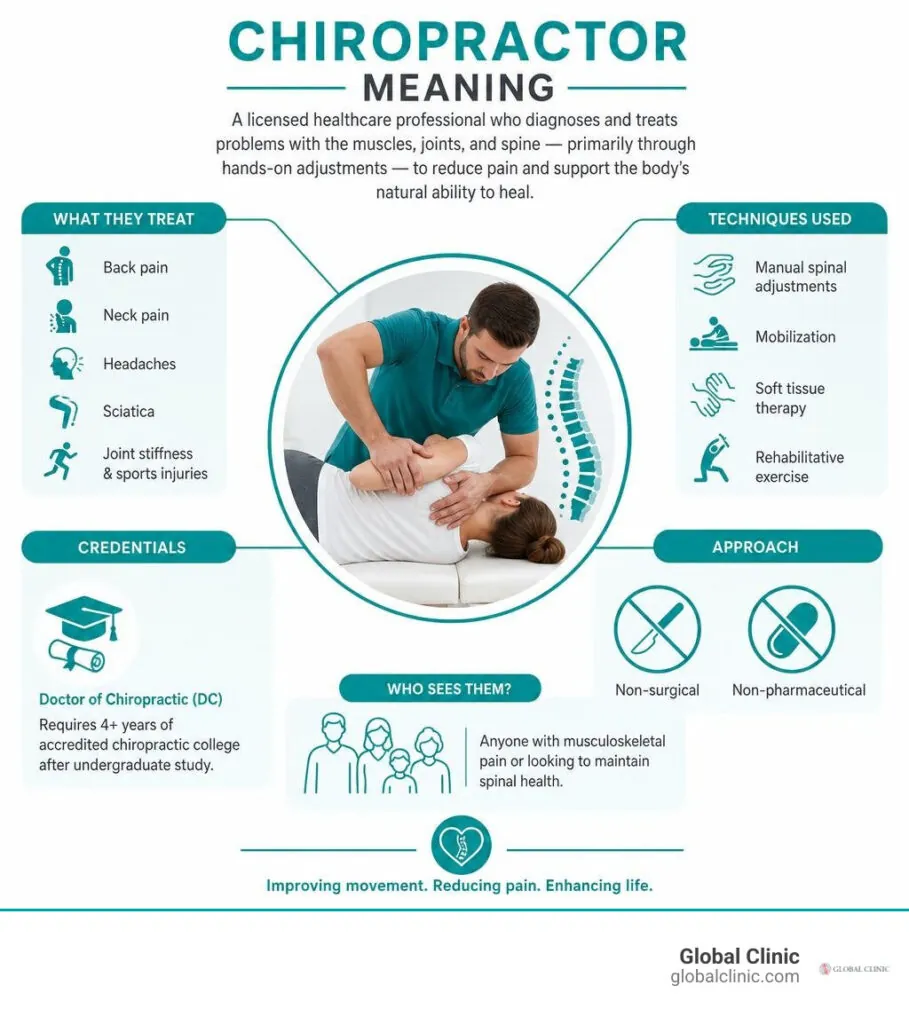
A chiropractor is a licensed healthcare professional who diagnoses and treats problems with the muscles, joints, and spine — primarily through hands-on adjustments — to reduce pain and support the body’s natural ability to heal.
Here’s the quick breakdown:
- What they treat: Back pain, neck pain, headaches, sciatica, joint stiffness, sports injuries
- How they treat: Manual spinal adjustments, mobilization, soft tissue therapy, rehabilitative exercise
- Credentials: Doctor of Chiropractic (DC) — requires 4+ years of accredited chiropractic college after undergraduate study
- Approach: Non-surgical, non-pharmaceutical, hands-on care
- Who sees them: Anyone with musculoskeletal pain or looking to maintain spinal health
Think of a chiropractor as a specialist in how your body moves and aligns — and what happens when it doesn’t. When your spine or joints are out of alignment, it can affect your nerves, your muscles, and your daily quality of life. Chiropractors are trained to find those misalignments and correct them.
As Practice Manager Anna Slavin, I work alongside multidisciplinary pain specialists at Global Pain & Spine Clinic — and understanding the chiropractor meaning is the first step I always recommend to patients exploring non-surgical relief options. In this guide, we’ll walk you through everything you need to know, from the history and science behind chiropractic care to what you can expect during your first visit.
Decoding the Chiropractor Meaning: Core Philosophy and Definition
To fully grasp the chiropractor meaning, we must look beyond basic dictionary entries. Major dictionaries provide a helpful foundation. For instance, the Merriam-Webster Definition of Chiropractor defines a chiropractor as a licensed health care professional who treats the musculoskeletal system, particularly through manual adjustment of the spinal vertebrae to address nervous system dysfunction.
Similarly, the Cambridge Dictionary English meaning explains that a chiropractor is a person who treats diseases by pressing joints, especially in the back. If you look at the Cambridge English Dictionary definition of chiropractic or the Collins Dictionary definition, you will find that it is a system of complementary medicine based on the active manipulation of body structures. The Oxford Advanced Learner’s Dictionary also notes its primary focus on treating the spine and musculoskeletal system to support overall health.
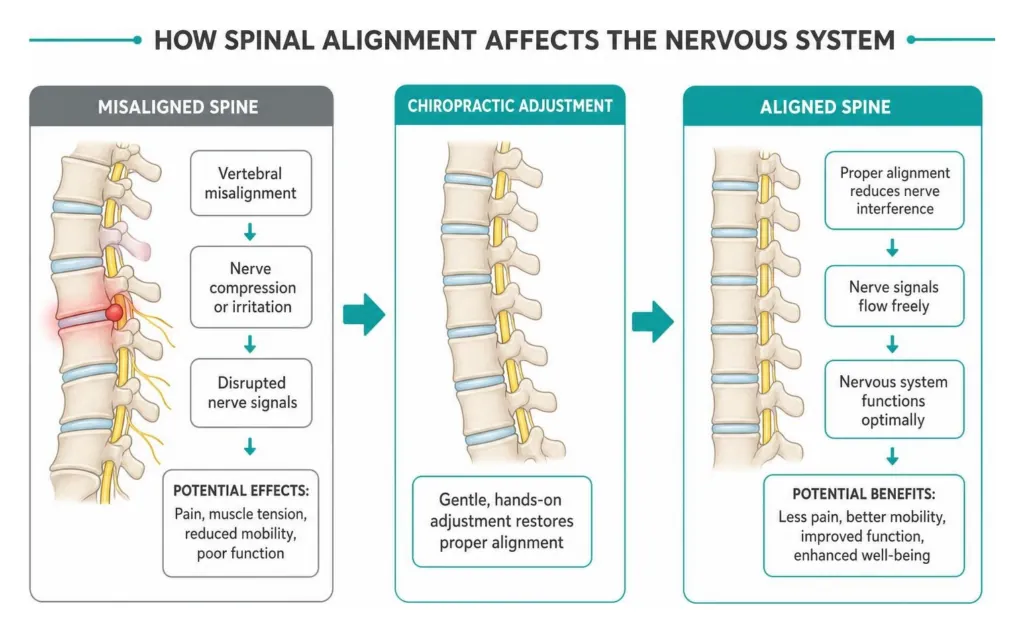
At its core, the philosophy of chiropractic care is built on the profound connection between your spine and your nervous system. Your brain communicates with the rest of your body through the spinal cord and nerves. When your spine is misaligned, this vital communication can be disrupted, leading to pain, muscle tension, and restricted mobility.
Rather than simply masking these symptoms with medication, chiropractic care focuses on restoring proper alignment. By doing so, we relieve pressure on the nerves and allow the body to engage its natural, self-healing mechanisms.
The Etymology and Historical Chiropractor Meaning
The linguistic roots of the profession offer a fascinating window into its clinical purpose. According to the Etymology, Origin & Meaning of Chiropractor, the term was coined in the late 1890s from two Greek words: cheir (meaning “hand”) and praktos (meaning “done” or “practical”). Combined, the word literally translates to “done by hand.”
The profession was founded in 1895 by Daniel David (D.D.) Palmer, who performed the first documented chiropractic adjustment on a janitor named Harvey Lillard in Davenport, Iowa. Palmer went on to establish the first chiropractic educational institution in 1897, setting the stage for what would become a major pillar of modern physical medicine.
Modern Healthcare and the Chiropractor Meaning Today
Today, chiropractic care has transitioned from its historical origins into a highly respected, evidence-based discipline of modern complementary medicine. Chiropractors are recognized as primary contact practitioners, meaning you do not need a referral from a general practitioner to seek their care.
In the United States, Canada, and Australia, chiropractic care is deeply integrated into mainstream wellness and rehabilitation. Statistically, between 6% and 12% of the U.S. and Canadian population utilizes chiropractic care at any given time. In 2022, 11% of Americans reported visiting a chiropractor, reflecting a growing public preference for non-invasive, drug-free pain management.
Modern practitioners collaborate closely with medical doctors, physical therapists, and other specialists to deliver holistic, patient-centered care. At our multidisciplinary center, we utilize Chiropractic Care as a core component of our integrated recovery programs, helping patients regain mobility and improve their overall quality of life.
What Does a Chiropractor Do? Techniques and Conditions Treated
A common misconception is that chiropractors only treat back pain. While they are experts in spinal health, their scope of practice extends much further. They focus on the entire neuromusculoskeletal system, which includes the nerves, muscles, ligaments, tendons, and bones.

Common Conditions Treated
Chiropractors treat a wide variety of acute and chronic physical issues. Some of the most common conditions we address in our daily practice include:
- Low Back Pain and Neck Pain: Often caused by poor posture, sedentary lifestyles, or sudden sprains.
- Tension Headaches and Migraines: Frequently linked to cervical spine misalignments and upper back muscle tension.
- Sciatica: Sharp, radiating pain traveling down the sciatic nerve due to spinal compression.
- Joint Stiffness and Arthritis: Restored joint mobility helps manage discomfort in the shoulders, hips, knees, and wrists.
- Whiplash and Sports Injuries: Targeted rehabilitation for soft tissue damage and joint trauma.
When looking at the broader benefits, proper alignment may support better sleep, athletic performance, and lower physical stress. For more insights on how these treatments can help you, read about 4 Ways Chiropractic Care Can Transform Your Life.
Chiropractic Techniques and Modalities
To treat these conditions, chiropractors utilize a diverse toolkit of manual and physical therapies:
- Diversified Technique: The most common form of chiropractic adjustment, involving a high-velocity, low-amplitude manual thrust to restore proper joint alignment.
- Activator Method: Uses a spring-loaded, handheld instrument to deliver a gentle, targeted impulse to specific joints.
- Spinal Decompression: A traction-based therapy that gently stretches the spine to relieve pressure on compressed discs and nerves.
- Ultrasound Therapy and Soft Tissue Techniques: Using sound waves and manual mobilization to reduce inflammation, break down scar tissue, and relax tight muscles.
- Rehabilitative Exercise: Custom home exercise programs designed to strengthen core muscles, correct posture, and prevent future injuries.
Chiropractor vs. Medical Doctor: Key Differences
While both Doctors of Chiropractic (DCs) and Medical Doctors (MDs) are highly trained healthcare professionals, their educational paths, treatment philosophies, and clinical approaches differ significantly.
| Feature | Doctor of Chiropractic (DC) | Medical Doctor (MD) |
|---|---|---|
| Primary Focus | Neuromusculoskeletal system and joint function | Overall systemic health, diseases, and organ systems |
| Treatment Methods | Manual adjustments, physical therapy modalities, exercise, lifestyle advice | Pharmaceuticals, surgery, medical procedures, specialty referrals |
| Philosophy | Non-invasive, conservative, drug-free, supporting natural self-healing | Evidence-based medical care, including medications and procedures |
| Diagnostic Tools | Physical exams, orthopedic/neurological tests, X-rays, MRI reviews | Lab work, imaging, diagnostic tests, biopsies |
Scope of Practice and Collaboration
Doctors of Chiropractic are specialized experts in musculoskeletal health. Because they do not prescribe medication or perform surgery, their focus remains entirely on conservative, non-invasive therapies.
This specialization makes them invaluable partners in a multidisciplinary healthcare team. Today, it is very common for medical doctors, orthopedic specialists, and chiropractors to work together. For example, a patient recovering from a major auto accident might receive pain management from an MD while undergoing spinal rehabilitation with a chiropractor and a physical therapist. This collaborative, patient-first approach ensures that you receive the most effective care for your specific needs. To learn how to select the right specialist for your situation, check our guide on how to Find the Best Chiropractor for Your Health Needs.
Education, Training, and Licensing Requirements
Becoming a licensed Doctor of Chiropractic requires a rigorous academic and clinical journey that matches the duration of many traditional medical programs.
Rigorous Academic Standards
Before entering an accredited chiropractic college, candidates must complete at least three to four years of undergraduate education, with a heavy emphasis on basic sciences like biology, chemistry, organic chemistry, and physics.
Once admitted to an accredited Doctor of Chiropractic program, students must complete:
- A minimum of 4,200 hours of classroom and laboratory instruction.
- At least 1,000 hours of fully supervised clinical training, treating real patients in a clinical setting.
- Extensive coursework in human anatomy, physiology, neurology, orthopedics, biochemistry, microbiology, and diagnostic imaging (X-ray interpretation).
To obtain a license to practice, graduates must pass a rigorous four-part national board exam administered by the National Board of Chiropractic Examiners (NBCE), as well as individual state jurisprudence exams. Furthermore, state laws require active chiropractors to complete annual continuing education courses to maintain their licenses and stay up to date on the latest medical research and clinical techniques.
Safety, Risks, and Scientific Evidence of Chiropractic Care
A common question among patients is whether chiropractic care is safe. When performed by a licensed, qualified professional, chiropractic care is generally considered a safe, non-invasive option for treating neuromusculoskeletal complaints.
Many patients experience relief or a feeling of lightness following an adjustment. Some may experience mild soreness, stiffness, or temporary discomfort in the treated areas, similar to the feeling after a strenuous workout. These mild side effects typically resolve on their own within 12 to 48 hours.
As with any medical intervention, there are specific contraindications. Chiropractic adjustments are generally not recommended for individuals with severe osteoporosis, spinal cancer, advanced arthritis in the treatment area, or unstable joint conditions. During your initial consultation, a thorough review of your medical history, physical exams, and diagnostic imaging is conducted to make sure care is appropriate for you.
What the Science Says
Over the past several decades, a growing body of scientific evidence has validated the clinical effectiveness of spinal manipulation. Major health organizations, including the National Institutes of Health (NIH) and the American College of Physicians, recommend spinal manipulation as a first-line, non-pharmacological treatment for acute and chronic low back pain. Clinical trials have shown that chiropractic care can help reduce pain, improve joint mobility, and help patients return to their normal daily activities without the need for prescription painkillers or invasive surgical procedures.
Frequently Asked Questions about Chiropractic Care
Is chiropractic care covered by health insurance?
Many health insurance plans, including Medicare and many PPO plans, cover chiropractic care. However, coverage can vary depending on your specific policy, and some plans may have limits on the number of annual visits allowed or require a referral from a primary care physician. We always recommend contacting your insurance provider or having our administrative team verify your benefits prior to your first appointment.
How many sessions are typically needed?
The number of sessions required depends entirely on your specific diagnosis, the severity of your symptoms, how long you have experienced the condition, and your individual recovery goals. An acute muscle strain or minor joint misalignment may resolve in just a few visits. Chronic conditions, such as herniated discs or long-term postural issues, may require a structured treatment plan over several weeks, followed by periodic maintenance visits to keep your spine functioning optimally.
Conclusion
Understanding the chiropractor meaning reveals a healthcare discipline focused on helping your body heal naturally and move freely with less pain. Whether you are dealing with persistent back pain, recovering from a sports injury, or looking to improve your posture, chiropractic care offers a conservative, non-surgical path to recovery.
At Global Pain & Spine Clinic, we serve Northern Chicago from our state-of-the-art multidisciplinary facility in Niles, IL. Our experienced, licensed specialists design personalized treatment plans that combine chiropractic care, physical therapy, acupuncture, and regenerative therapies to address the root cause of your pain. We proudly serve patients across the entire region, including Chicago, IL, Skokie, IL, Glenview, IL, Park Ridge, IL, Morton Grove, IL, Des Plaines, IL, and Mount Prospect, IL.
If you are ready to take the first step toward lasting pain relief and improved mobility, we invite you to read our Chiropractor Chicago IL Complete Guide or call our Niles clinic at (847) 299-7000 to schedule an appointment.