






What PRF Injections Before and After Actually Look Like (And What the Photos Tell You)
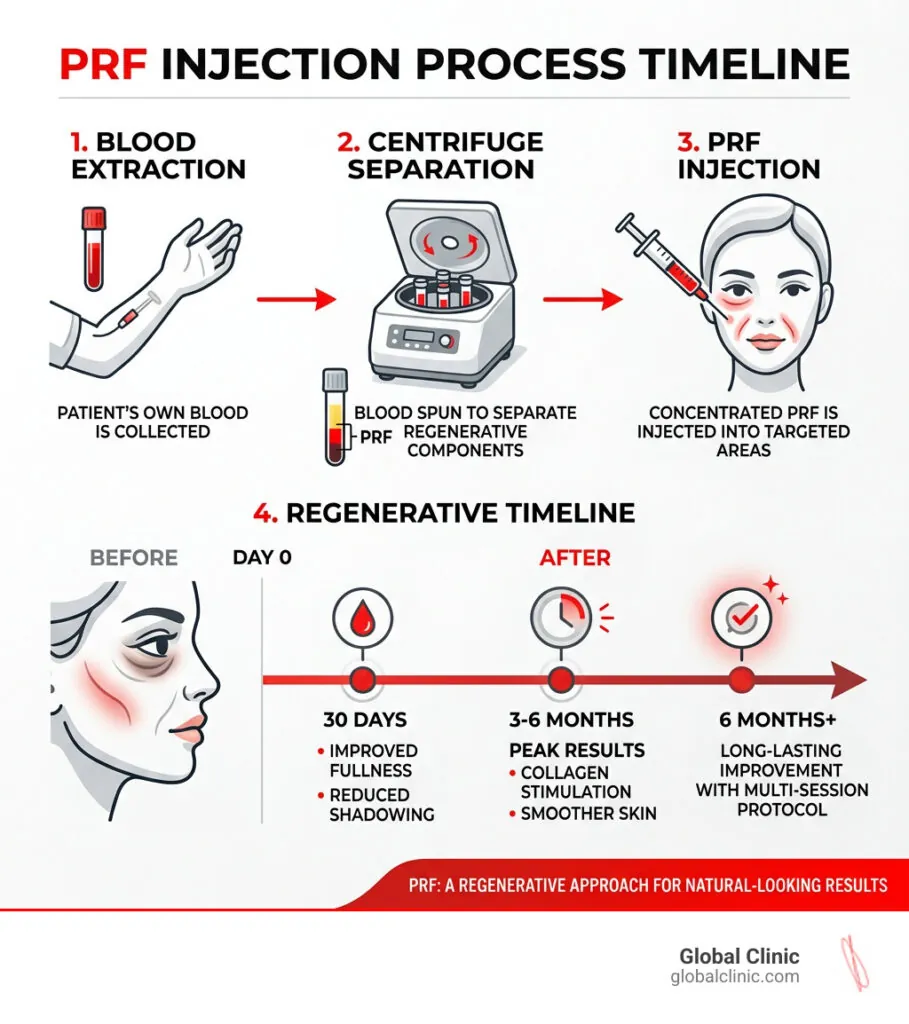
Before-and-after photos of PRF injections typically show a gradual, natural-looking improvement in the under-eye area — reduced hollowing, less shadowing, and smoother skin texture.
Here’s a general timeline of what patients may see:
| Timeframe | What You Typically See |
|---|---|
| 30 days | Some patients notice improved fullness and fewer dark circles after 1 session |
| 3-8 weeks | First noticeable collagen changes begin |
| 3-6 months | Peak results — maximum volume and brightness |
| 12-30+ months | Long-lasting improvement with proper multi-session protocol |
The most common concerns PRF treats:
- Dark under-eye circles and shadowing
- Tear trough hollowing
- Fine lines and skin laxity
- Loss of volume around the nasolabial folds
But here’s what photos can’t always show you: why the results happen, how long they actually last, and whether you’re a good candidate. That’s what this article is for.
PRF (Platelet-Rich Fibrin) is not a filler. It’s a regenerative treatment — meaning it works by stimulating your body’s own collagen and elastin production over time. Results build gradually rather than appearing overnight.
I’m Anna Slavin, Practice Manager at Global Clinic, where our practitioners bring over 20 years of experience in the US and Europe with regenerative and non-surgical treatments, including PRF. Whether you’re new to PRF or comparing it to fillers you’ve already tried, what follows is a clear, evidence-based breakdown of what the results really mean.
What are PRF Injections and How Do They Differ from PRP?
When we talk about regenerative medicine, Platelet-Rich Fibrin (PRF) is often called the “second generation” of blood concentrates. While many people are familiar with Platelet-Rich Plasma (PRP), PRF takes the technology a step further. Both treatments involve drawing a small amount of your own blood, but the way that blood is processed makes a big difference in your results.
PRF is an autologous treatment, meaning it comes entirely from your own body. It contains a high concentration of platelets and white blood cells. Unlike its predecessor, PRF is processed at a lower centrifuge speed, which allows the heavier white blood cells to remain within the platelet layer. This creates a powerful cocktail of growth factors ready to repair damaged tissue. You can explore more about our regenerative services to see how these biological tools are used across various medical fields.
The Science of the Fibrin Scaffold
The “F” in PRF stands for Fibrin. This is what makes the treatment well suited to under-eye hollowing. During the preparation process, a natural fibrin matrix forms. Think of this as a biological “scaffold” or a slow-release sponge.
While PRP releases its growth factors in one quick burst (usually within the first hour), the fibrin matrix in PRF traps the platelets and releases growth factors slowly over 7 to 10 days. This extended release keeps the healing cascade active for much longer, leading to more robust tissue repair and collagen synthesis. This is why patients often see continued improvement months after their last session.
Why PRF is the “Next Generation” of PRP
There are three main technical reasons why we prefer PRF for facial rejuvenation:
- Anticoagulant-Free: PRP requires an acid anticoagulant (like ACD-A) to keep the blood from clotting in the tube. PRF uses no additives. This means the pH remains natural, which often results in less stinging during the injection.
- Slow-Spin Technology: By spinning the blood slower, we preserve more of the delicate white blood cells that are often lost in the high-speed “hard spin” required for PRP.
- Albumin Gel: In some advanced protocols, we can heat a portion of the plasma to create a natural “albumin gel.” When mixed back with the liquid PRF, it creates a natural filler that provides immediate volume while the growth factors work on long-term repair.
Real Results: PRF Injections Before and After for Under-Eyes
The under-eye area is notoriously difficult to treat. The skin is thin, the anatomy is complex, and traditional fillers can sometimes look artificial or cause puffiness (the Tyndall effect). This is where PRF can be a good option.
In before-and-after photos, the changes are typically subtle and natural-looking. We aren’t just “filling” a hole; we are thickening the skin and improving the vascularity of the area. This leads to a reduction in the “darkness” that often comes from thin skin allowing underlying blood vessels to show through.
What to Expect from PRF Injections Before and After Photos
A typical “before” photo shows a distinct shadow in the tear trough. Some patients look brighter and more rested about 30 days after one or two sessions, although results vary.
Some patients notice improvements within about 30 days of a session. However, the most noticeable changes usually occur after a series of three treatments. At this stage, the skin texture is refined, and the “hollow” look is significantly softened.
Specific Concerns Treated by PRF
We use PRF to target several key aesthetic and functional concerns:
- Tear Troughs: Filling the deep grooves between the lower eyelid and the cheek.
- Dark Circles: Brighter eyes by increasing skin thickness and collagen.
- Nasolabial Folds: Softening the “smile lines” using natural volume.
- Fine Lines: Smoothing out “crepey” skin texture around the eyes.
The Treatment Timeline: When Will You See PRF Results?
Patience is a virtue when it comes to regenerative medicine. Unlike synthetic fillers that provide instant (though temporary) gratification, PRF is a marathon, not a sprint.
| Phase | Timeline | What is Happening |
|---|---|---|
| Immediate | Days 1-3 | Mild swelling provides a “preview” of volume; growth factors begin to signal cells. |
| The “Dip” | Days 4-14 | Swelling subsides; you may look like you did “before” as the liquid absorbs. Don’t panic! |
| Early Changes | 3-8 Weeks | First visible changes in skin brightness and texture as new collagen starts to form. |
| Peak Results | 3-6 Months | Maximum volume and skin quality improvements are realized. |
| Longevity | 14-30+ Months | Results vary; many patients need maintenance sessions. |
Getting the Most from Your PRF Treatment
For the best results, we usually recommend a multi-session protocol. For most patients at our Niles clinic, this involves 2 to 3 initial treatments spaced 4 to 8 weeks apart.
Following this initial series, many patients find that a single maintenance session every 12 months is enough to keep the area looking youthful. Factors like age and lifestyle play a role in how long results last.
Recovery and Aftercare Essentials
The recovery for PRF is generally very straightforward, but following these steps helps you get the best outcome:
- Manage Swelling: Some swelling is normal for 24-48 hours. You can use the “EIC” method (Elevation, Ice, and Compression) as recommended by the Cleveland Clinic. Keep your head elevated while sleeping for the first night.
- Avoid NSAIDs: This is crucial. Ask your provider about avoiding anti-inflammatory medications like ibuprofen (Advil, Motrin) for several days; do not stop aspirin or other prescribed medications without talking to your doctor. PRF relies on a natural inflammatory response to trigger healing. If you suppress that inflammation, you suppress your results! Ask your provider which pain reliever is appropriate if you have discomfort.
- Hydration: Drink plenty of water. Your cells need a hydrated environment to rebuild tissue effectively.
Comparing PRF to Traditional Fillers and Combination Therapies
A common question we hear at Global Clinic is: “Should I just get Restylane?”
Traditional Hyaluronic Acid (HA) fillers like Restylane or Juvederm are great for instant volume. However, the under-eye area is very delicate. Fillers can sometimes migrate, cause a bluish tint (Tyndall effect), or look lumpy if the patient has thin skin.
PRF offers a natural alternative; because it comes from your own blood, the risk of allergic reaction is low. While it doesn’t provide the same “instant” lift as a thick gel filler, it may improve skin quality over time. For those interested in a holistic approach, you can learn more about our wellness treatments that complement these aesthetic procedures.
Enhancing Outcomes with Combination Protocols
Sometimes, the best results come from a “team effort.”
- Microneedling: Using PRF topically during microneedling (the “Vampire Facial” style) improves surface texture while the injections handle the deep hollowing.
- Skincare Prep: Some clinical cases show that using medical-grade skincare, such as tretinoin or Vitamin C, for a few weeks before your PRF session can “prime” the skin to respond even better to the growth factors.
- Fillers: In cases of extreme hollowing, we sometimes combine PRF with a small amount of HA filler. The filler provides the structure, while the PRF improves the skin health on top of it.
Ideal Candidates vs. Contraindications
Many people are good candidates for PRF because of its favorable safety profile. However, your lifestyle and health status will affect your results.
- Ideal Candidates: Those with mild to moderate hollowing, dark circles, or fine lines who want a natural, long-term solution.
- The Smoking Factor: Smoking or vaping significantly reduces the quality of your platelets and impairs blood flow. If you smoke, your results will likely be less impressive and won’t last as long.
- Platelet Disorders: If you have a low platelet count or a blood-clotting disorder, PRF may not be effective for you.
- Hydration and Nutrition: Patients who eat a high-protein diet and stay hydrated generally produce “richer” fibrin, leading to better outcomes.
Frequently Asked Questions about PRF Injections Before and After
How many sessions are needed for optimal results?
While some patients see a difference after one session, we typically recommend a series of 3 treatments. This “builds” the collagen in layers, leading to the 14-30 month longevity seen in the most successful cases.
Is the PRF procedure painful?
Most patients describe it as a series of small pinpricks. We often use a local anesthetic or a numbing cream to make the process as comfortable as possible. Because PRF has a natural pH, it typically stings less than PRP injections.
Conclusion
Does PRF actually work? Clinical research and patient experience suggest it can help many patients, although results vary. By moving away from synthetic “fixes” and toward regenerative medicine, you are investing in the long-term health and thickness of your skin.
At Global Clinic, we pride ourselves on providing personalized, innovative care. Whether you are coming from Arlington Heights, Mount Prospect, or elsewhere in Northern Chicago, our goal is to help you achieve results that make you look like a refreshed version of yourself—never “done” or “fake.”
Ready to see what your own “after” photo could look like? Our team in Niles is here to guide you through the process.
Call Global Clinic at (847) 299-7000 to schedule a PRF consultation at our office at 8565 W. Dempster St. in Niles.