







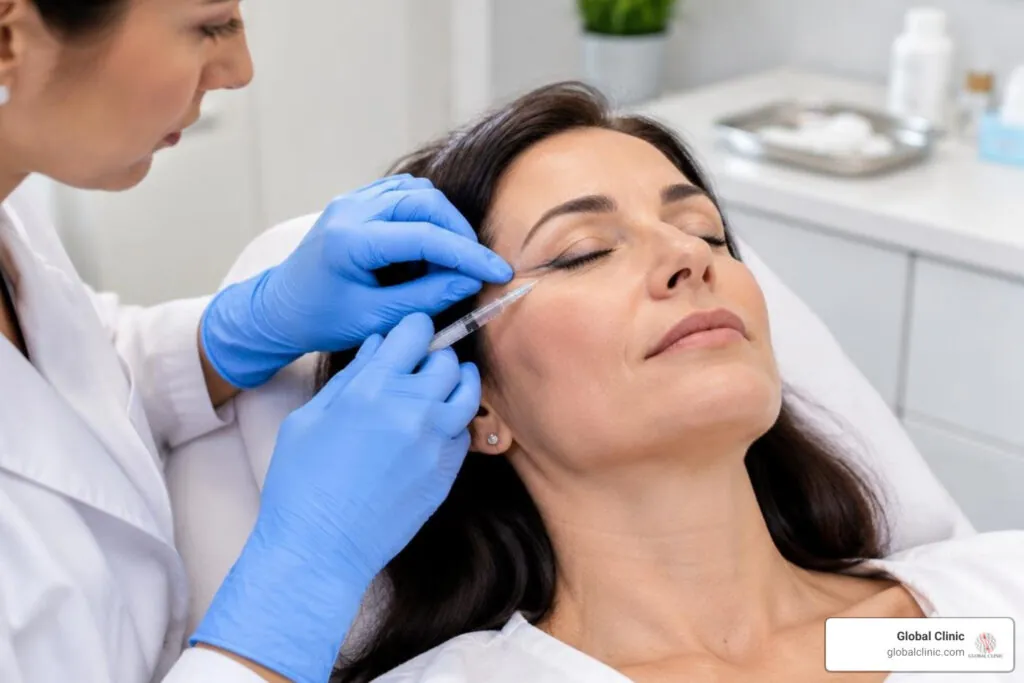
What to Know Before Botox Injections Near the Eyes
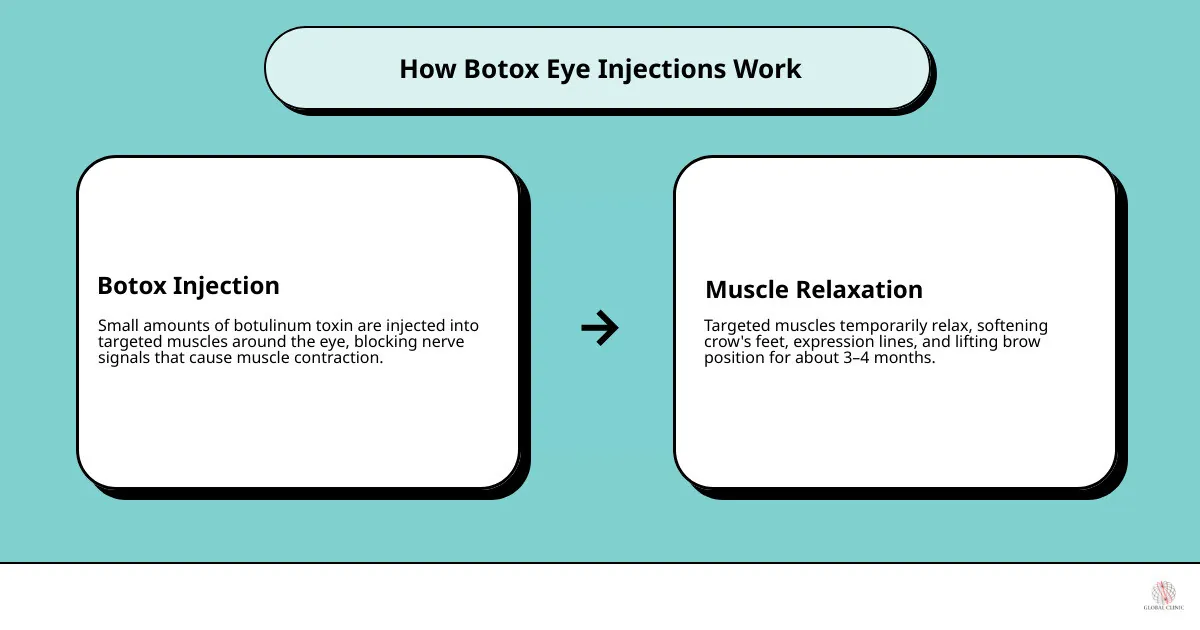
Botox eye injections place small amounts of medication in targeted muscles near the eyes, not inside the eyeball. Cosmetic injections can soften crow’s feet by temporarily relaxing the muscles that form them. Botox may also treat medical conditions such as eyelid spasms or misaligned eyes, but those treatments need an eye specialist. Global Clinic offers cosmetic BOTOX, not treatment for medical eye conditions.
The injections usually take only a brief visit. You may feel a small pinch or notice temporary redness or bruising. Results develop over several days and often last about three to four months.
I’m Anna Slavin, Practice Manager at Global Pain & Spine Clinic. I help patients learn about our cosmetic options, including botox eye injections, while our providers assess their treatment goals.
If you are exploring related treatments, you can read about anti wrinkle injections or learn how brow lift injections work.
What Botox eye injections can treat, and what cosmetic treatment can address
Botox is a brand of botulinum toxin type A. In tiny, purified doses, it blocks the chemical signal (acetylcholine) that nerves send to muscles. Without that signal, the injected muscle contracts less, so it relaxes for a period of time.
That one mechanism explains two very different uses. In cosmetic care, relaxing a muscle softens the lines that form when it repeatedly contracts. In medical care, relaxing an overactive or misaligned muscle can ease spasms or help eye position. The American Academy of Ophthalmology explains Botox for eye conditions, and the National Eye Institute has information on blepharospasm. Interestingly, the toxin was first developed for eye use by an ophthalmologist, and its cosmetic benefit was noticed when patients treated for eyelid spasms showed fewer wrinkles.
On the cosmetic side, our providers can discuss concerns such as:
- Crow’s feet, the lines that fan out from the outer corners of the eyes
- Frown lines between the brows and forehead lines
- Brow position, since relaxing certain muscles can subtly lift the brow
- Fine lines in the under-eye area, which depend on your anatomy and are assessed individually
Wrinkles fall into two groups. Dynamic wrinkles appear with expression, such as squinting or smiling, and respond best to Botox. Static wrinkles remain when the face is at rest, often from sun exposure and aging. Botox may soften them over time, but deeper static lines may need other approaches. Our skin rejuvenation page covers other options.
How Botox eye injections work around the eye
The goal is targeted muscle relaxation. The muscle that circles the eye (orbicularis oculi) creates crow’s feet, while nearby muscles move the brow and forehead. Because these muscles sit close to the muscles that lift the eyelid and move the eyeball, placement matters.
A review of ophthalmic botulinum toxin in the research literature notes that the toxin can spread a few centimeters from the injection site, and that low-volume, concentrated solutions and injection points kept roughly 1 cm from the bony edge of the eye socket help limit unwanted spread. The effect is temporary because the body gradually recovers nerve function.
Which medical eye conditions may be treated with Botox?
Eye specialists use Botox for conditions that involve muscle overactivity or poor muscle control. These include:
- Strabismus (misaligned eyes), the first condition for which the FDA approved Botox, in 1989
- Blepharospasm, uncontrollable blinking or eyelid twitching
- Hemifacial spasm, involuntary twitching on one side of the face
- Entropion, an eyelid that turns inward
- Excessive tearing
- Corneal protection, where a temporary eyelid droop shields the surface of the eye
- Facial paralysis such as Bell’s palsy
Some uses, such as excessive tearing, are off-label. The same research review describes Botox as a safe and effective alternative to surgery in selected cases. These conditions require an ophthalmologist’s evaluation and are not treated at our clinic.
What to expect from Botox eye injections
Most cosmetic visits begin with a consultation. Your provider will ask about your goals, your medical history, and any medications and supplements you take. Be sure to mention previous Botox treatments, allergies, neuromuscular conditions, and whether you are pregnant or breastfeeding. Your provider will also look at how your face moves when you smile, squint, and raise your brows, then build an injection plan around those movements.
Our guide on what to expect during anti-wrinkle injections walks through a typical visit in more detail.

What happens during Botox eye injections?
The appointment is usually short. A typical visit looks like this:
- Your skin is cleansed, and injection points may be marked.
- Your provider injects tiny amounts with a very fine needle into specific muscles.
- You may feel mild pinching or stinging. A numbing cream or ice may be offered if you are concerned about discomfort.
- You can usually go back to your routine right away.
Redness, small bumps, or bruising can occur and typically fade within a few days. Botox is a prescription medicine, so it should only be given by a trained provider. Never self-dose. Good questions to ask any injector include how often they treat the eye area, what dose and number of injection points they plan, and what to do if something feels wrong.
What should you do after treatment?
Follow the instructions your injector gives you, because they can differ by product and area. Common guidance from medical sources includes not rubbing or pressing on the treated area and staying upright for a few hours so the product stays where it was placed. A Cleveland Clinic overview of Botox and botulinum toxin injections suggests avoiding hard exercise for 24 hours. Watch your face over the next two weeks. If something looks or feels different, contact the provider who treated you.
Risks, side effects, and who may need to avoid treatment
Botox is generally considered safe when given by a licensed, skilled provider, but side effects can happen. Most are mild and short-lived:
- Soreness, swelling, redness, or bruising at the injection site
- Headache
- Dry or watery eyes, or eye irritation
- Eyelid droop (ptosis) or brow asymmetry
Eyelid droop is the best-known concern. It can occur if the medication affects the muscle that raises the lid, usually on one side. Double vision from spread to nearby eye-movement muscles is even less common and mostly follows crow’s feet treatment. These effects can appear around two weeks after treatment and typically resolve as the product wears off, over weeks to months. Providers may use prescription eye drops to lift a drooping lid temporarily.
Rarely, the toxin spreads beyond the injection site. Seek emergency care right away for trouble breathing or swallowing, slurred speech, or a severe allergic reaction such as widespread swelling or rash. Call your provider promptly for vision problems, blurred vision, or worsening drooping eyelids.
Some people should not have treatment or need a careful review first, including those who are pregnant or breastfeeding, have a neuromuscular condition such as myasthenia gravis, have an existing droopy eyelid or weak facial muscles, are allergic to Botox ingredients, or have an infection at the injection site. Tell your provider about all medications and supplements. Never stop a prescribed medication without talking to your doctor, and ask your provider about anything that may affect bruising. Medical eye treatment should always be handled by an ophthalmologist.
Can Botox accidentally drip into the eye?
An injection into a muscle is not the same as a droplet landing on the eye surface. A microdroplet can occasionally cling to a fine needle as it moves between points. Doctors responding to this question report no problems from such small exposures, because tears dilute the product and wash it toward the tear ducts, and Botox is poorly absorbed through the cornea and conjunctiva.
If product touches your eye, do not rub it. Rinse gently if your injector advises, and let them know. Contact the injector or an eye-care professional if you have lasting irritation, blurred vision, or drooping. Get urgent care for severe or sudden symptoms.
How long results last, insurance coverage, and common questions
Botox does not work instantly. Effects begin over several days, usually peak within one to two weeks, and then fade gradually. Results are temporary, which is why repeat treatment is needed to maintain the look, and individual response varies. If your goal is a lifted brow, our article on how brow lift injections work explains what to expect.
How long do Botox eye injections last?
Most people notice a change within one to three days, with full results around 7 to 14 days. Effects on muscles commonly last about three to four months. Duration depends on your muscle strength, the area, and the dose. Some people find that with regular treatment they can space visits further apart. Autonomic effects, such as on tear glands, can last longer, around six to nine months, according to the ophthalmic review above.
Are Botox injections for eye conditions covered by insurance?
Coverage for medical eye treatment depends on the diagnosis, medical necessity, your policy, and sometimes prior authorization. Conditions such as blepharospasm, hemifacial spasm, and strabismus are FDA-approved uses and are more likely to be covered. Off-label uses are often paid out of pocket. Confirm coverage with your insurer and your treating ophthalmologist.
Global Clinic offers cosmetic BOTOX, not therapeutic eye injections, and cosmetic injections are generally not covered by insurance. For services we do offer, coverage depends on your plan – our team can help you check.
What if Botox wears off or a drop gets into my eye?
As the treatment fades, movement and lines gradually return. Stopping does not harm the underlying skin or muscles, and you can schedule another session when you are ready. A surface drop is not the same as an injection, but seek professional advice for persistent irritation, drooping, double vision, or other vision changes.
Conclusion
If you have eyelid twitching, double vision, misaligned eyes, or other medical eye concerns, see an ophthalmologist. If you want to soften lines around the eyes, a cosmetic consultation is the right first step.
Global Pain & Spine Clinic provides non-surgical, multidisciplinary care under one roof, including physical therapy, chiropractic care, pain management, personal injury and workers’ compensation care, and wellness. Our cosmetic BOTOX service is one part of that care, and you can explore our cosmetic injection options online.
We have one location at 8565 W. Dempster St., Niles, IL 60714, with on-site parking. Our hours are Monday–Friday 9 AM–8 PM and Saturday 9 AM–4 PM. Patients from Chicago, Skokie, Glenview, Park Ridge, Morton Grove, Des Plaines, Mount Prospect, Norridge, and Rosemont visit us in Niles.
Call Global Clinic in Niles at (847) 299-7000 to schedule an appointment.