







What Is an NAD Injection — and Is It Right for You?
An NAD injection delivers nicotinamide adenine dinucleotide (NAD+) directly into your body, bypassing the digestive system so it does not depend on absorption through the gut.
Here is a quick overview of what you need to know:
- What it is: A compounded injection of NAD+, a coenzyme found in every living cell
- How it works: Delivers NAD+ directly into tissue or a vein, skipping the gut for much higher absorption than oral supplements
- Main uses: Energy support, cognitive clarity, healthy aging, metabolic health
- Who it is for: Adults experiencing fatigue, brain fog, or age-related decline — or those seeking proactive cellular health support
- Key caution: Not recommended during pregnancy, with active cancer, or without physician oversight
NAD+ is not optional for your cells — it powers the conversion of food into energy, repairs DNA, and keeps your mitochondria running. The problem is that by middle age, your body may hold roughly half the NAD+ it had in your twenties. That decline is linked to fatigue, slower recovery, and a growing list of age-related changes happening at the cellular level.
Injectable NAD+ has become one of the most discussed tools in regenerative and functional medicine — and for good reason. Unlike oral supplements, which rely on conversion pathways that may be impaired with age, injections place NAD+ exactly where it needs to go.
I’m Anna Slavin, Practice Manager at Global Pain & Spine Clinic, where our multidisciplinary team draws on over 20 years of global medical experience to help patients across the Chicago area recover, perform, and age well — including through evidence-informed therapies like NAD injection. In the sections ahead, we walk you through everything you need to make an informed decision about whether this therapy belongs in your wellness plan.
What is NAD+ and Why is it Crucial for Cellular Health?
To understand why an NAD+ injection may help, we first need to look at what is happening inside your cells. Every single process in your body—from the blinking of your eye to the complex repair of damaged tissue—requires energy. That energy is generated by your mitochondria, the tiny cellular powerhouses that produce a molecule called adenosine triphosphate (ATP).
However, your mitochondria cannot produce ATP without a vital helper: nicotinamide adenine dinucleotide, or NAD+. This coenzyme acts as an essential electron carrier in cellular metabolism, facilitating the chemical reactions that convert the nutrients from your food into usable cellular fuel.
Beyond basic energy production, NAD+ plays a critical role as an exclusive co-substrate for two major families of enzymes:
- Sirtuins (SIRT1-SIRT7): Often referred to as the “longevity genes,” sirtuins regulate cellular stress responses, reduce inflammation, and help maintain mitochondrial function.
- PARPs (Poly ADP-Ribose Polymerases): These enzymes act as cellular first responders, identifying and repairing damaged DNA to preserve genomic stability.
If you want to dive deeper into the chemistry, you can read our guide on NAD explained simply.
The catch is that NAD+ levels do not remain constant. As we age, our bodies face a double whammy: we produce less NAD+, and we consume more of it due to chronic low-grade inflammation (often called “inflammaging”) and cumulative DNA damage. In fact, research shows that by middle age, our tissues may hold roughly half the NAD+ they had in our youth. In mice, NAD+ levels decrease twofold by mid-age, correlating directly with the onset of mitochondrial dysfunction and multiple age-related health challenges.
This steady drain is heavily driven by an enzyme called CD38, which multiplies as we age and rapidly destroys our remaining NAD+ stores. When NAD+ levels bottom out, cellular repair slows down, mitochondria struggle, and we begin to experience the classic signs of aging: fatigue, brain fog, and slower physical recovery.
What is an NAD Injection and How Does It Work?
An NAD+ injection is one way to replenish this vital coenzyme. Instead of relying on your digestive tract to process precursors, the injection delivers pure, active NAD+ directly into your body’s tissues.
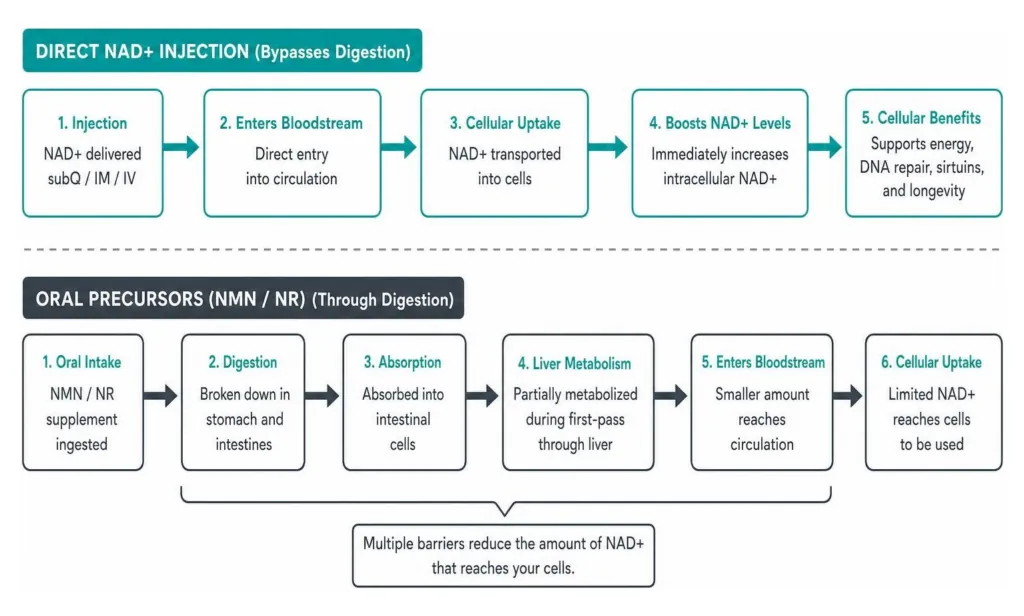
When you receive a subcutaneous (under the skin) or intramuscular (into the muscle) injection, the coenzyme enters the surrounding tissues and is gradually absorbed into the bloodstream. This direct delivery bypasses the metabolic bottlenecks of the gut and liver. Once in circulation, cells take up the NAD+ to replenish their internal pools, immediately providing the raw materials needed for ATP synthesis and DNA repair.
For a detailed look at the clinical applications, check out our article on What Is Nad Injections. To weigh the overall safety and clinical considerations, you can also explore our guide on Exploring The Benefits And Risks Of Nad Injections For Enhanced Health.
How an NAD Injection Differs from Oral Supplements
Many people wonder why they cannot simply take a pill to boost their NAD+ levels. The answer lies in basic human biology. The NAD+ molecule is relatively large and highly unstable in the digestive tract. If you swallow a pure NAD+ pill, your stomach acids and digestive enzymes break it down before it can ever reach your bloodstream.
To get around this, oral supplements typically use NAD+ precursors like Nicotinamide Mononucleotide (NMN) or Nicotinamide Riboside (NR). While these precursors are smaller and can survive digestion, they still have to pass through the liver, where they undergo first-pass metabolism. This process significantly reduces their efficiency, leaving oral bioavailability estimated at under 10% to 20%. While a daily precursor pill can offer modest, steady support over several weeks, it cannot match the rapid, concentrated cellular uptake of an injection.
Our medical team explores this dynamic in detail in our article, Does Nad Therapy Really Work Or Is It Just Expensive Water. By bypassing the digestive tract completely, injections deliver the active coenzyme without depending on digestion, which is why some patients prefer this route for fatigue or age-related decline.
The Science-Backed Benefits of NAD+ Restoration
Restoring your NAD+ levels is like upgrading your cells’ battery capacity. When your cells have a steady supply of this coenzyme, they can perform their daily maintenance and energy-generation tasks with ease.

Patients who undergo NAD+ restoration frequently report a wide range of systemic improvements, which we detail in our resource on Nad Injections Benefits. To see what changes patients commonly ask about, read our review of Nad Injections Before And After results.
Cognitive Function and Neuroprotection
One of the first places people notice a drop in NAD+ is in their brain. The brain is an incredibly energy-hungry organ, consuming about 20% of the body’s total energy. When cellular energy drops, mental fatigue, forgetfulness, and brain fog quickly set in.
By administering NAD+ directly, we can support the brain’s metabolic needs. NAD+ activates sirtuins, which help protect neurons from oxidative stress, support synaptic plasticity (the brain’s ability to adapt and learn), and promote overall neuroprotection. Many of our patients in Niles, IL, and the surrounding Chicago suburbs find that our NAD+ Injections may support focus and mental clarity during demanding work weeks.
Cellular Longevity and Anti-Aging
On a deeper level, NAD+ restoration targets the very hallmarks of cellular aging. NAD+ is a required co-substrate for sirtuins and PARP enzymes, which are involved in genomic stability and DNA repair.
NAD+ supports processes involved in cellular energy, although research in humans is still early. For a complete, comprehensive look at how this cellular rejuvenation works over time, you can read our Nad Therapy Complete Guide.
NAD+ Delivery Methods: Comparing Injections, IVs, and Oral Supplements
Choosing how to receive your NAD+ depends on your health goals, your schedule, and how quickly you want to see results. Below is a simple comparison of the most common administration routes:
| Feature | Oral Supplements (NMN/NR) | Subcutaneous (SubQ) / Intramuscular (IM) Injection | Intravenous (IV) Infusion |
|---|---|---|---|
| Bioavailability | Low to moderate | High | Complete (delivered directly into the bloodstream) |
| Absorption Speed | Slow (hours through digestion) | Gradual (slow release over 1–4 hours) | Immediate (direct to bloodstream) |
| Administration | Self-administered pill | In-clinic shot by licensed staff | In-clinic medical professional |
| Best For | Daily baseline maintenance | Steady, convenient weekly support | Rapid, high-dose cellular loading |
For those looking for the fastest and most intensive way to saturate their cells, an Nad Infusion is often preferred. You can learn more about the systemic advantages of this approach in our article on the Benefits Of Nad Infusion.
IV Infusion vs. Subcutaneous Injection
At Global Pain & Spine Clinic, we often view IV infusions and subcutaneous injections as complementary therapies rather than competitors.
- The IV Infusion (The Loading Dose): An IV drip delivers a high dose of NAD+ directly into your vein over a period of 2 to 4 hours. This gradually replenishes your NAD+ levels.
- The Subcutaneous Injection (The Maintenance): Subcutaneous injections use smaller, highly concentrated doses that are administered in our clinic by licensed clinical staff. This slow-release method keeps your NAD+ levels elevated between your larger IV sessions.
Dosage, Administration Protocols, and Safety Guidelines
Because NAD+ is a highly active coenzyme, its administration requires careful planning and professional medical oversight. We customize every treatment protocol to the individual patient, keeping safety at the forefront.
Safety, Side Effects, and Contraindications
While NAD+ is a naturally occurring coenzyme that is generally well-tolerated, rapid administration can cause temporary, mild side effects. During an IV infusion, running the drip too quickly can cause temporary flushing, chest fluttering, mild nausea, or a headache. These symptoms usually ease quickly when the drip rate is slowed down.
For subcutaneous injections, the most common side effect is a localized burning or stinging sensation at the injection site, which usually fades within a few minutes to an hour. Some patients also experience a temporary wave of high energy or a mild headache shortly after the injection.
There are certain situations where NAD+ injections should be avoided entirely:
- Active Cancer: Because NAD+ supports cellular energy and survival pathways, there is a theoretical concern that it could support the growth of active cancer cells. Anyone with a history of active malignancy must obtain direct oncologist clearance.
- Pregnancy and Breastfeeding: Due to a lack of clinical safety data, we do not recommend NAD+ injections for pregnant or nursing mothers.
- Severe Organ Dysfunction: Patients with severe kidney or liver disease require careful medical evaluation before beginning therapy.
At our Multidisciplinary Health and Wellness Clinic, our medical team reviews your medical history and current medications before recommending any NAD+ protocol.
Frequently Asked Questions about NAD+ Injections
How long does it take to see results from NAD+ injections?
The onset of action varies from person to person. Some patients report a noticeable boost in mental clarity, alertness, and physical energy within hours of their first injection or IV session. For others, the effects are more subtle and build gradually over two to three weeks of consistent therapy as cellular energy reserves are slowly replenished.
Are NAD+ injections painful?
Subcutaneous injections of NAD+ can cause a temporary stinging or burning sensation at the injection site. This is a normal reaction to the compound itself. To minimize discomfort, our licensed staff inject slowly.
Who should avoid NAD+ injection therapy?
NAD+ injections are contraindicated for individuals under the age of 18, pregnant or breastfeeding women, and anyone with active or historic cancer without direct oncologist approval. Patients with unstable cardiovascular disease, severe liver or kidney impairment, or those taking specific psychiatric medications should undergo a comprehensive medical evaluation at our clinic before starting treatment.
Conclusion
Your cellular health is the foundation of your overall vitality, mobility, and cognitive sharpness. As NAD+ levels naturally decline with age, proactive restoration through targeted nad injection therapy offers a direct, highly bioavailable pathway to help you feel like yourself again.
At Global Pain & Spine Clinic, serving patients in Niles, IL, Chicago, IL, and surrounding communities like Skokie, Glenview, Park Ridge, Morton Grove, Des Plaines, and Mount Prospect, we believe in a whole-body, patient-first approach. With practitioners who bring over 20 years of experience in the US and Europe, our multidisciplinary team is dedicated to designing personalized wellness plans that help you recover and thrive without relying on unnecessary medications.
NAD+ Pricing at Global Clinic
- NAD+ IV infusion: 150 mg – $200, 250 mg – $275, 500 mg – $350
- NAD+ intramuscular injection: $55 per injection, or $200 for a pack of 4
- New patient offer: consultation with our doctor plus your first NAD+ injection – $99
Anyone considering NAD+ therapy should first meet with our doctor for a consultation. We review your health history and medications and recommend whether NAD+ is right for you and which option fits your goals. NAD+ is a self-pay wellness service and is not FDA-approved to diagnose, treat or prevent any disease; prices are subject to change. See our NAD+ therapy page for details.
If you are ready to explore how NAD+ therapy can support your cellular energy, focus, and longevity, we invite you to take the next step. Call our Niles clinic at (847) 299-7000 to schedule an appointment for NAD+ therapy.