






Why Chronic Pain Demands More Than Temporary Fixes
PRP for pain management is a regenerative treatment that uses concentrated platelets from your own blood to promote healing and reduce pain in damaged tissues. Here’s what you need to know:
Quick Answer: What is PRP for Pain Management?
- What it is: Platelet-Rich Plasma therapy injects a concentrated solution of your own platelets into injured or painful areas
- How it works: Platelets release growth factors that stimulate tissue repair, reduce inflammation, and promote natural healing
- What it treats: Osteoarthritis, tendon injuries (tennis elbow, jumper’s knee), rotator cuff problems, plantar fasciitis, chronic back pain, and ligament injuries
- Expected results: Pain reduction often begins within 3-4 weeks, with continued improvement over several months
- Key advantage: Uses your body’s natural healing mechanisms without surgery or long-term medication use
Living with chronic pain from arthritis, a nagging sports injury, or persistent back problems doesn’t just hurt physically—it steals your ability to enjoy life. You’ve probably tried traditional treatments like pain medications, cortisone shots, or physical therapy. Some may have helped temporarily, but the pain keeps coming back.
Chronic musculoskeletal pain affects over 1 billion people worldwide, with a prevalence rate of 20-33%. Low back pain and knee pain are the most common complaints. Traditional approaches often mask symptoms without addressing the underlying tissue damage that causes the pain.
That’s where regenerative medicine comes in. PRP therapy represents a shift from simply managing pain to actually healing damaged tissues. Instead of weakening tissue like cortisone injections can, or masking pain like NSAIDs do, PRP for pain management works with your body’s natural repair mechanisms.
Research shows impressive results. Studies demonstrate that PRP injections for knee osteoarthritis produce a 44.7% improvement in pain and function scores—significantly better than the 12.6% improvement seen with hyaluronic acid injections. For tennis elbow, patients experienced a 91% improvement in pain scores compared to just 42.2% with steroid injections.
I’m Ana Vinikov, and as Practice Manager at Global Clinic, I’ve witnessed how PRP for pain management transforms patients’ lives by addressing the root cause of their discomfort rather than just covering it up. Our team has spent over 20 years studying regenerative treatments, and we’ve seen PRP help patients avoid surgery and reclaim active lifestyles.
Decoding Platelet-Rich Plasma: Your Body’s Natural Healer
At Global Clinic, we understand the desire for solutions that work with your body, not against it. That’s precisely what Platelet-Rich Plasma (PRP) therapy aims to achieve. It’s a cutting-edge regenerative treatment that harnesses the incredible healing power already present within you.
What is PRP and How is it Prepared?
So, what exactly is PRP? Simply put, it’s a concentrated solution of platelets derived from your own blood, suspended in a small amount of plasma. Think of it as a super-charged version of your body’s natural healing toolkit.
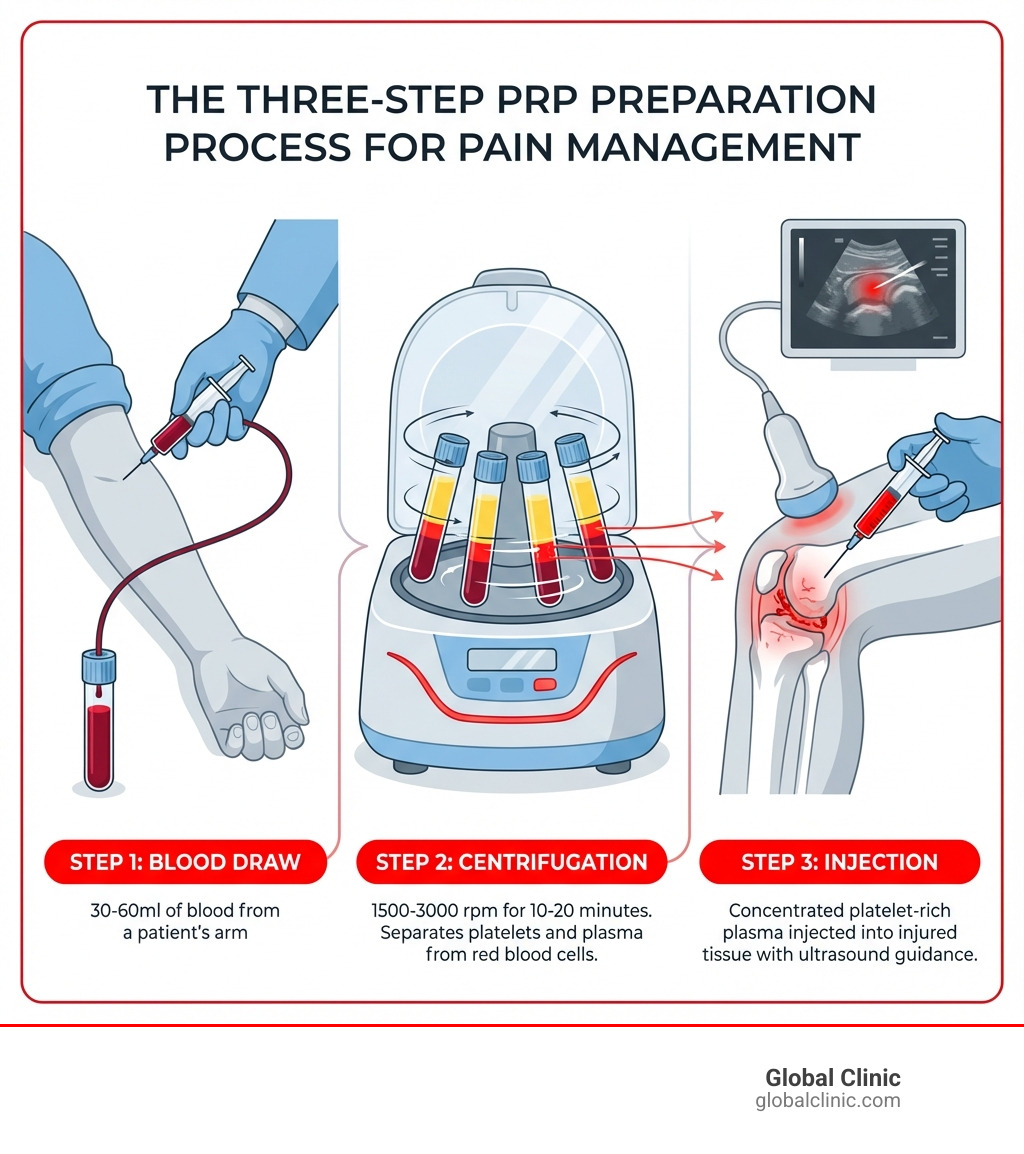
The preparation process for PRP is straightforward and typically completed right in our office. It involves three key steps:
- Blood Draw: First, one of our experienced medical professionals will draw a small sample of your blood, similar to what you’d experience during a routine blood test. We usually collect between 30 to 60 milliliters.
- Centrifugation: This blood sample is then placed into a specialized device called a centrifuge. This machine spins the blood at high speeds (typically 1500-3000 revolutions per minute for 10-20 minutes). This spinning action separates the blood components based on their density. The red blood cells settle at the bottom, the plasma (the liquid portion of your blood) rises to the top, and in between, we find a concentrated layer of platelets and some white blood cells. This concentrated layer is the platelet-rich plasma.
- Extraction and Activation: Once separated, our team carefully extracts the PRP. Before injection, we may activate the platelets using substances like calcium chloride or autologous thrombin. This activation prompts the platelets to release their powerful healing factors. The resulting injectable solution contains a platelet concentration that is typically 2-6 times higher than that found in normal whole blood, sometimes even up to 500% more concentrated.
Because PRP is made from your own blood, it’s considered an autologous treatment, significantly reducing the risk of allergic reactions or rejection.
The Science Behind the Healing
The magic of PRP for pain management lies in the platelets. These tiny blood cells are far more than just clotting agents; they are packed with hundreds of bioactive substances, including a potent cocktail of growth factors, cytokines, chemokines, and proteins. When these concentrated platelets are injected into an injured or painful area, they initiate a powerful healing cascade:
- Growth Factor Release: Activated platelets release an abundance of growth factors, such as Platelet-Derived Growth Factor (PDGF), Changing Growth Factor-beta1 (TGF-β1), Basic Fibroblastic Growth Factor (bFGF), Vascular Endothelial Growth Factor (VEGF), Epidermal Growth Factors (EGF), and Insulin-like Growth Factor-1 (IGF-1). These are the master keys that open up your body’s repair mechanisms.
- Cell Recruitment and Proliferation: These growth factors signal to other cells in the body, including stem cells, to migrate to the injury site. They stimulate cell reproduction and proliferation, encouraging the growth of new, healthy tissue.
- Inflammation Modulation: While some initial inflammation is necessary for healing, chronic inflammation can hinder it. PRP can help modulate the inflammatory response, turning down the “volume” on harmful, persistent inflammation. It contains anti-inflammatory mediators and can even shift macrophages from a pro-inflammatory (M1) to an anti-inflammatory (M2) phenotype.
- New Blood Vessel Formation (Angiogenesis): VEGF, a key growth factor in PRP, promotes the formation of new blood vessels. This improved blood supply delivers essential nutrients and oxygen to the damaged tissues, further accelerating healing.
- Collagen Production and Tissue Repair: PRP stimulates the production of collagen, the primary building block of tendons, ligaments, and cartilage. This leads to the repair and strengthening of damaged tissues, promoting tissue regeneration and improving overall structural integrity. For example, in tendons and ligaments, PRP can trigger new collagen development, leading to tightening and strengthening.
Essentially, PRP for pain management works by amplifying your body’s innate ability to heal itself, addressing the underlying tissue damage rather than just masking the symptoms. This focus on natural healing, supported by scientific research on PRP mechanisms, is why we are so excited about its potential at Global Clinic for our patients in Northern Chicago, including our clinics in Arlington Heights, Barrington, Crystal Lake, and Schaumburg.
The Evidence: Conditions Effectively Treated with PRP for Pain Management
The growing body of research on PRP for pain management continues to shed light on its effectiveness across a wide range of musculoskeletal conditions. At Global Clinic, we carefully evaluate the evidence to determine the best applications for our patients.
Effectiveness of PRP for Pain Management in Osteoarthritis
Osteoarthritis (OA) is a degenerative joint disease affecting millions, causing pain, stiffness, and reduced mobility. It occurs when the protective cartilage on the ends of your bones wears down over time. For many of our patients in areas like Glenview, Northbrook, and Lake Zurich, OA is a significant source of chronic pain.
Current research strongly supports the use of PRP for pain management in osteoarthritis, especially in the knee:
- Knee Osteoarthritis: A systematic review of eighteen Level 1 studies involving over 1,600 patients showed remarkable results. The mean improvement in Western Ontario and McMaster Universities Osteoarthritis Index (WOMAC) total scores was significantly higher in the PRP group (44.7%) compared to the hyaluronic acid group (12.6%). This indicates substantial improvement in pain, stiffness, and functional limitations for patients receiving PRP. We’ve also seen literature increasingly show PRP is effective in treating low-to moderate-grade knee osteoarthritis, with some results lasting up to 2 years. The use of leukocyte-poor PRP (LP-PRP) is often recommended for knee OA due to its anti-inflammatory properties.
- Ankle Osteoarthritis: While rarer than knee or hip OA, ankle OA is often post-traumatic. Studies suggest that PRP injections can provide symptomatic relief and potentially postpone the need for surgery.
- Temporomandibular Joint (TMJ) Osteoarthritis: For those experiencing jaw pain and limited movement, PRP has shown promise. Patients have reported improvements in pain-free mouth opening and a reduction in overall pain severity.
PRP for pain management offers a compelling alternative or adjunct therapy to help manage OA symptoms and improve cartilage health, allowing many to maintain an active lifestyle.
Tackling Tendon and Ligament Injuries
Tendons and ligaments are crucial for movement and stability, but they are also highly susceptible to injury, often leading to chronic pain. Our patients from Des Plaines, Palatine, and Schaumburg frequently seek solutions for these persistent issues. PRP has shown particular strength in treating many tendinopathies:
- Lateral Epicondylitis (Tennis Elbow): This common condition, affecting the outside of the elbow, responds very well to PRP. A randomized study of 83 patients found that PRP injections resulted in a 91% mean improvement in VAS (Visual Analogue Scale) pain scores, significantly outperforming steroid injections which showed only a 42.2% improvement. This is why we often consider leukocyte-rich PRP (LR-PRP) as a primary treatment for this condition.
- Patellar Tendinopathy (Jumper’s Knee): For athletes and active individuals, patellar tendinopathy can be debilitating. In a study comparing PRP with focused Extracorporeal Shock Wave Therapy (ESWT), the PRP group showed greater improvement at both 6 months (86.7% vs. 73.7%) and 12 months (91.3% vs. 77.6%), indicating its long-term benefits.
- Rotator Cuff Tendinopathy: This shoulder condition can cause significant pain and limit arm movement. While corticosteroids offer short-term relief (3-6 weeks), research suggests that PRP for pain management may yield better long-term outcomes (over 24 weeks) for rotator cuff tendinopathy. PRP can also be considered a safe alternative to corticosteroids, though more research is needed for routine recommendation.
- Plantar Fasciitis: A common cause of heel pain, plantar fasciitis can be stubborn. Studies suggest that PRP injections may be superior to corticosteroid injections for reducing pain and improving function, especially given PRP’s improved safety profile.
- Achilles Tendinopathy: While PRP has shown promise in some tendinopathies, current evidence demonstrates a lack of efficacy for Achilles tendinopathy. Not all conditions respond equally.
- Ligament Injuries (e.g., ACL and Ankle Sprains): For Anterior Cruciate Ligament (ACL) reconstruction, PRP may help decrease patellar tendon donor site pain, though it hasn’t consistently shown to improve graft integration or maturation. For acute ankle sprains, routine use of PRP is not yet recommended, but some limited evidence suggests LP-PRP may benefit elite athletes with high ankle sprains.
Relief for Other Musculoskeletal Pain
Beyond joints and major tendons, PRP for pain management is also being explored and used for other challenging pain conditions:
- Myofascial Pain Syndrome: This condition involves chronic muscle pain in specific areas called trigger points. A randomized controlled trial showed that 4 weeks after injection, the average pain on the visual analogue scale (VAS) was remarkably lower in the PRP group (0.9) compared to the lidocaine group (3.4). This highlights PRP’s potential for sustained relief.
- Low Back Pain: A widespread problem, low back pain can stem from various sources. PRP for pain management has shown efficacy in addressing lumbar facet joint pain, lumbar epidural pain, and sacroiliac joint pain. Small studies also suggest it could be a relatively safe option for discogenic low back pain in patients who haven’t found relief through other treatments.
- Adhesive Capsulitis (Frozen Shoulder): This painful condition severely restricts shoulder movement. A study found that a single injection of PRP was more effective than corticosteroid injection in improving pain, disability, and shoulder range of movement at 12 weeks, offering a long-term solution.
The Patient Journey: From Consultation to Recovery
Starting on a journey with PRP for pain management is a collaborative process. At Global Clinic, we prioritize your understanding and comfort every step of the way, from your initial visit to your full recovery.
What to Expect During and After a PRP Procedure
When you choose PRP for pain management with us, here’s what your experience will typically look like:
- Initial Consultation and Diagnosis: Our first step is always a thorough evaluation. We’ll discuss your medical history, perform a physical exam, and may use imaging tests to accurately diagnose your condition. This helps us determine if PRP is the right treatment for you. We serve patients across Northern Chicago, from Elmhurst to Evanston, and our personalized approach ensures we understand your unique needs.
- The Procedure:
- Blood Draw: As mentioned, a small amount of your blood will be drawn. We advise our patients to be well-hydrated and to have eaten prior to the procedure to prevent lightheadedness.
- PRP Preparation: Your blood is then processed in a centrifuge to concentrate the platelets.
- Injection: Once the PRP is ready, our skilled physicians will inject the solution into the targeted area. For precision and effectiveness, we often use ultrasound guidance, especially for joint injections or tendon injuries. This ensures the PRP reaches the exact site of injury, maximizing its healing potential. A local anesthetic is typically used to minimize discomfort during the injection. The entire process, from blood draw to injection, usually takes a couple of hours.
- After the Injection:
- Immediate Sensations: It’s completely normal to experience some mild pain, soreness, or bruising at the injection site. This is actually a positive sign! It indicates that the PRP is stimulating an inflammatory response, which is the first step in your body’s healing process. These symptoms typically subside within two to three days.
- Activity Modification: We will provide specific instructions regarding activity levels. While you can often return to light activities within 24 hours, strenuous activities should be avoided for a period to allow the healing process to take hold.
- Rehabilitation: Physical therapy is strongly recommended after or between PRP for pain management treatments to maximize the benefits and support your recovery. Our team will work with you to create a comprehensive rehabilitation plan.
Comparing PRP for Pain Management to Traditional Options
Many patients come to us having tried various traditional treatments without lasting success. Let’s look at how PRP for pain management stacks up against some common alternatives:
| Feature | PRP (Platelet-Rich Plasma) | Cortisone Injections | Surgery | NSAIDs (Non-Steroidal Anti-Inflammatory Drugs) |
|---|---|---|---|---|
| Mechanism | Stimulates natural healing & tissue regeneration | Reduces inflammation, suppresses immune response | Repairs or replaces damaged tissue mechanically | Reduces inflammation and pain |
| Onset of Relief | Gradual, typically weeks to months | Rapid, often within hours to days | Post-operative recovery, then gradual improvement | Rapid, within hours |
| Duration of Effects | Months to a year or longer, can be long-term | Short-term, weeks to a few months | Can be long-term, but involves recovery period | Short-term, daily dosing needed |
| Tissue Impact | Heals, strengthens, and regenerates tissue | Can weaken tissue, temporary relief, no tissue regeneration | Direct repair, but invasive, scarring, and risks | Symptom management, no healing, potential side effects with long-term use |
| Risks | Minimal (injection site pain/bruising), low infection risk | Tissue damage, infection, skin discoloration, temporary pain flare | High (infection, blood clots, nerve damage, long recovery) | Gastrointestinal, cardiovascular, kidney issues with prolonged use |
A key advantage of PRP for pain management is that it’s a minimally invasive alternative that leverages your body’s natural healing abilities. Unlike cortisone, which can weaken tissue with repeated use and only provides temporary relief, PRP aims to heal and strengthen the affected area. It also allows many to avoid or delay more aggressive treatments like surgery, which comes with its own set of risks and a lengthy recovery period. For our patients in communities like Mount Prospect, Wood Dale, and Melrose Park, avoiding surgery is often a significant goal.
Potential Risks and Side Effects
One of the most appealing aspects of PRP for pain management is its excellent safety profile. Because the treatment uses your own blood, the risk of adverse reactions is very low.
- Common Side Effects: The most common side effects are mild and temporary. These include soreness, bruising, and some swelling at the injection site. This is a normal part of the healing process and typically resolves within a few days.
- Rare Side Effects: As with any injection, there’s a very small risk of infection, bleeding, or nerve irritation. Our adherence to strict sterile techniques and the use of ultrasound guidance significantly minimizes these risks.
- Allergic Reactions: Since PRP is derived from your own blood, the risk of an allergic reaction is virtually non-existent, a significant advantage over many pharmaceutical interventions.
We will always discuss all potential benefits and risks with you during your consultation to ensure you make an informed decision about your pain management plan.
Understanding Treatment Outcomes and Logistics
Choosing a treatment like PRP for pain management involves understanding not just the procedure itself, but also the expected timeline for results, factors that might influence your outcome, and practical considerations like cost and insurance.
Timeline for Results and Longevity of Effects
Patience is a virtue when it comes to regenerative medicine. Unlike quick-fix solutions, PRP for pain management stimulates your body’s natural healing processes, which take time.
- Initial Results: Many patients begin to notice initial improvements, such as a decrease in pain, within a few weeks (typically 3-4 weeks) after the injection. Some even report a notable decrease in pain within 24-48 hours.
- Peak Effects: The full benefits of tissue healing and regeneration, leading to significant pain reduction and improved function, typically manifest over several months. You can expect continued improvement over the first 1-2 months and beyond.
- Duration of Relief: The effects of a PRP injection can last for six months to a year or even longer, depending on the condition being treated and individual patient factors. For instance, for rotator cuff tendinopathy, PRP may yield better long-term outcomes (over 24 weeks) compared to corticosteroids.
- Multiple Treatments: While many see results with a single injection, some individuals may require more than one treatment for optimal healing and pain control. We typically space additional injections at least 8 weeks apart. There’s no inherent limit to the number of treatments, and risks don’t increase with frequency.
Factors That Can Influence Your PRP Results
While PRP for pain management offers significant promise, its effectiveness can vary from person to person. Several factors play a role in influencing your outcome:
- Severity and Type of Injury: The extent and nature of the tissue damage (e.g., acute vs. chronic, partial tear vs. severe degeneration) can impact how well PRP works.
- Location of the Injury: Different tissues and areas of the body may respond differently to PRP.
- Patient’s Overall Health: Factors like age, nutritional status, lifestyle (smoking, activity level), and underlying health conditions can affect your body’s healing capacity. Generally, healthier individuals tend to respond better.
- Type of PRP Preparation: As we discussed earlier, there are different types of PRP (leukocyte-rich vs. leukocyte-poor) and various preparation methods. The specific composition of the PRP, including platelet concentration and the presence of white blood cells, can influence its therapeutic effect.
- Adherence to Post-Procedure Protocol: Following our post-injection guidelines, including activity modification and participating in recommended physical therapy, is crucial for optimal results. Rehabilitation plays a vital role in strengthening the healed tissues and restoring function.
Our expert team at Global Clinic, serving communities like Buffalo Grove, Kildeer, and Long Grove, will assess these factors to provide you with a realistic expectation of outcomes.
Cost, Insurance Coverage, and Regulatory Status
Understanding the financial and regulatory aspects of PRP for pain management is an important part of your decision-making process.
- Cost: PRP treatments are typically an out-of-pocket expense. The cost can vary depending on the specific condition being treated, the number of injections required, and the preparation method used. At Global Clinic, we pride ourselves on transparent and affordable pricing, ensuring you understand all costs upfront. For example, our pricing for PRP treatments varies based on the kit size and complexity of the injection (e.g., Intradiscal injections may be priced differently).
- Insurance Coverage: Currently, PRP for pain management is often considered an investigational or experimental treatment by many insurance companies. This means that, for most uses, it is not typically covered by insurance. We recommend checking with your specific insurance provider, but be prepared for the likelihood of self-payment.
- Regulatory Status: The equipment used to prepare PRP and the injections themselves have been cleared by the FDA. However, the procedure itself is considered investigational for most musculoskeletal uses. This means that while the components are approved, the specific application of PRP for many conditions has not yet received official FDA approval, which contributes to the variability in insurance coverage. Research is ongoing, and the field continues to evolve.
Conclusion: Taking the Next Step Towards a Pain-Free Life
Living with chronic pain can feel like an endless battle, but at Global Clinic, we believe in empowering you with innovative solutions that tap into your body’s remarkable ability to heal. PRP for pain management offers a compelling, minimally invasive, and natural approach to addressing the root causes of your discomfort, rather than just masking the symptoms.
We’ve explored how PRP is prepared from your own blood, the powerful science behind its regenerative effects, and the growing evidence supporting its use in conditions like osteoarthritis, tendinopathies, and chronic back pain. We’ve also walked through what to expect during your patient journey, how PRP compares to traditional treatments, and the logistical considerations of this advanced therapy.
If you’ve been living with persistent pain, if traditional treatments haven’t provided the lasting relief you seek, or if you’re looking for a non-surgical option that promotes genuine healing, it might be time to consider PRP for pain management. Our experts in regenerative medicine, serving Northern Chicago from Crystal Lake to Palatine and all surrounding communities, are dedicated to creating personalized treatment plans custom to your unique needs. We believe in providing innovative care in a state-of-the-art facility, helping you reclaim an active and pain-free life.
Take the next step towards lasting relief. Learn more about how our regenerative medicine services can help you.