





When Your Achilles Won’t Heal: What PRP Can (and Can’t) Do
PRP for Achilles tendon treatment is one of the most talked-about options for people stuck in a cycle of chronic heel and calf pain that just won’t quit.
Quick answer: Does PRP help the Achilles tendon?
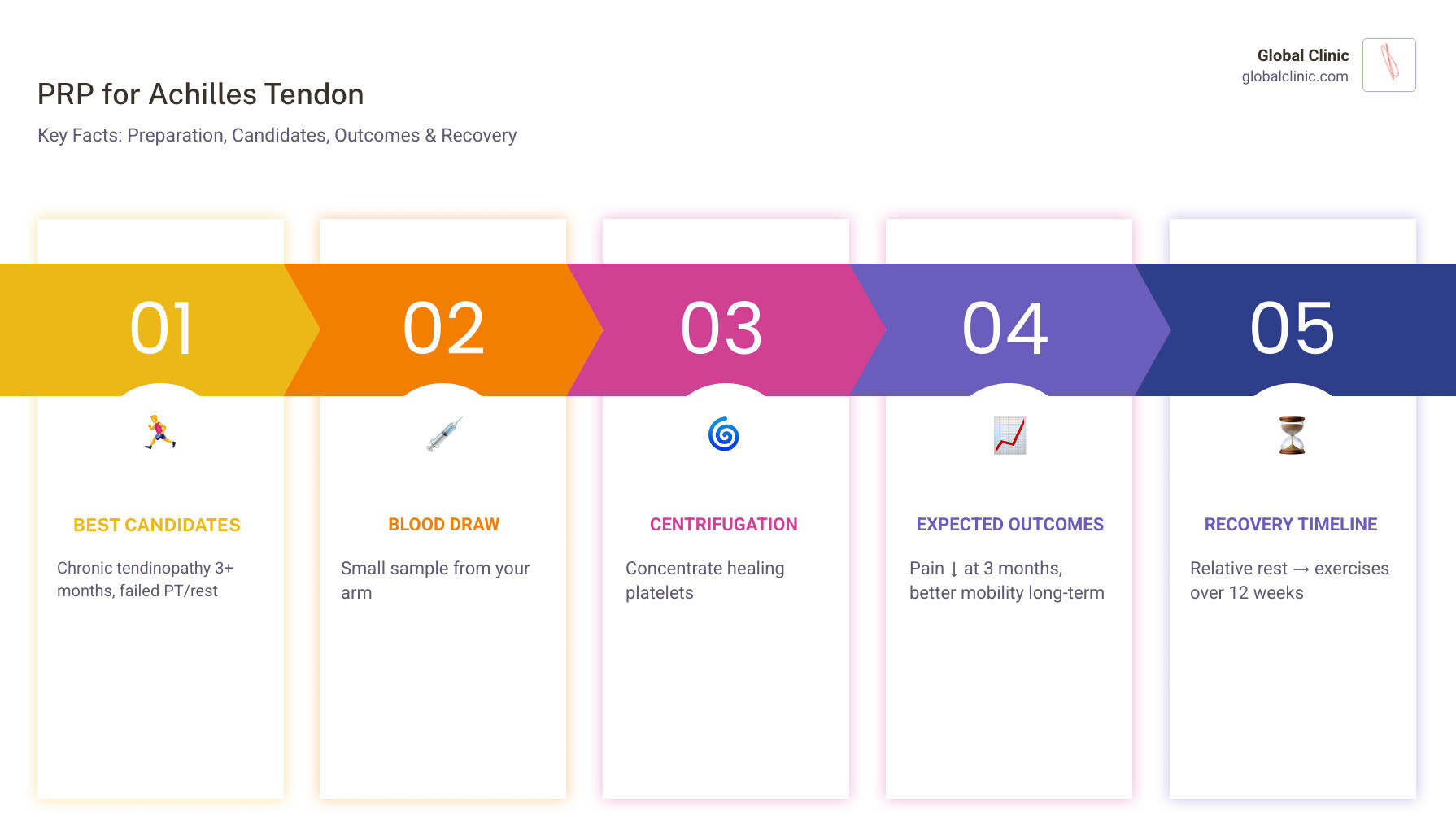
- Best for: Chronic Achilles tendinopathy lasting 3+ months that hasn’t responded to physical therapy or rest
- How it works: A small sample of your own blood is spun in a centrifuge to concentrate healing platelets, then injected directly into the damaged tendon
- What the research says: PRP may reduce pain at 3 months and improve long-term ankle mobility after rupture, but functional scores (VISA-A) are often similar to placebo by 6 months
- Not ideal for: Complete Achilles ruptures requiring surgery, or cases where conservative care hasn’t been tried yet
- Safety: Very low risk — it uses your own blood, and serious side effects are rare
The Achilles tendon is the strongest in the body. But it has a problem: poor blood supply. That makes it slow to heal and quick to become a long-term source of pain.
Up to 5% of runners deal with Achilles tendinopathy every year. And for roughly 1 in 5 of those people, symptoms drag on for five years or more.
That’s a long time to be sidelined from the activities you love — whether that’s running the lakefront trail, keeping up with your kids, or simply walking without wincing.
PRP therapy steps in here as a regenerative option. Instead of masking the pain, it attempts to restart the healing process by flooding the injured tissue with concentrated growth factors from your own blood.
The science is promising — though, as we’ll cover, it’s not a magic fix for everyone.
I’m Ana Vinikov, Practice Manager at Global Clinic, where our multidisciplinary team has spent over 20 years helping patients across Chicago and Europe find lasting, non-surgical relief — including through regenerative treatments like PRP for Achilles tendon injuries. In this guide, I’ll walk you through exactly how it works, what the research actually shows, and whether it might be the right next step for you.
Key terms for PRP for Achilles tendon:
Understanding PRP for Achilles Tendon Injuries
Platelet-Rich Plasma (PRP) is a concentrated form of your own blood that contains a high level of platelets. While we usually think of platelets as the cells that help our blood clot, they are actually tiny “powerhouses” filled with growth factors. When we use PRP for Achilles tendon issues, we are essentially taking the body’s natural healing toolkit and concentrating it directly where it’s needed most.
The process begins with a simple blood draw. We then place that blood in a centrifuge—a machine that spins at high speeds—to separate the platelets from the red blood cells. This results in a plasma “boost” that has a platelet concentration 2 to 6 times higher than normal blood.
In our Northbrook and Chicago area clinics, we see two primary types of Achilles issues:
- Chronic Tendinopathy: This is the “wear and tear” injury. Over time, the tendon fibers become disorganized and degenerate. Because the Achilles has a notorious lack of blood supply (especially in the “mid-portion” about 2-6 cm above the heel), it struggles to repair itself.
- Acute Rupture: A sudden tear, often described by our patients as feeling like they were kicked in the back of the leg.
The goal of Scientific research on PRP effectiveness is to determine if this “platelet boost” can jumpstart repair in these stubborn tissues.
Is PRP for Achilles Tendon Effective for Ruptures?
When it comes to a full Achilles tendon rupture (ATR), the role of PRP is usually as an “augmentation” or a helping hand to the primary treatment. Whether you are treating a rupture conservatively (in a boot) or surgically, the goal of PRP is to improve the quality of the new tissue.
According to a recent Meta-analysis of PRP for Achilles disease, the results for ruptures are interesting. While PRP didn’t necessarily get people back to sports faster than a placebo, it did show a significant improvement in ankle mobility at the 12-month mark. For many of our active patients in Elk Grove Village and Schaumburg, that extra degree of mobility is the difference between feeling “stiff” and feeling like themselves again. However, it’s important to note that for major ruptures, PRP is rarely a replacement for the mechanical stability provided by surgery or proper bracing.
Candidates for PRP for Achilles Tendon Therapy
We often recommend PRP for Achilles tendon for patients who fall into the “gap” of care—those for whom rest and physical therapy didn’t work, but who aren’t ready for (or don’t need) invasive surgery.
You might be a good candidate if:
- You’ve had Achilles pain for more than 3 months (chronic tendinosis).
- Imaging (Ultrasound or MRI) shows thickening or small micro-tears in the tendon.
- You want a natural, autologous (from your own body) treatment.
- You’ve failed conservative treatments like eccentric loading exercises or orthotics.
If you are curious about how this fits into a broader plan, you can find More info about regenerative treatments on our main services page.
The Biological Mechanism: How Platelets Stimulate Repair
Why does putting platelets in a tendon actually do anything? It comes down to the “Healing Cascade.” When a tendon is chronically injured, it gets stuck in a state of failed healing. The tissue is disorganized, and the body has essentially “given up” on fixing it.
When we inject PRP, we release a flood of bioactive proteins. One of the most important is VEGF (Vascular Endothelial Growth Factor). Because the Achilles has such poor blood flow, VEGF is crucial—it signals the body to grow new micro-capillaries (neovascularization), bringing much-needed oxygen and nutrients to the site.
Furthermore, PRP stimulates fibroblast proliferation. Fibroblasts are the cells responsible for creating collagen. By increasing the number of these cells and giving them the “building blocks” they need, PRP helps the tendon replace weak, disorganized “Type III” collagen with the strong, functional “Type I” collagen that a healthy Achilles needs to handle the force of running or jumping.
Growth Factors and Tendon Stem Cells
PRP doesn’t just work on its own; it recruits help. It contains:
- EGF (Epidermal Growth Factor): Promotes cell growth and collagen formation.
- FGF (Fibroblast Growth Factor): Essential for tissue repair.
- PDGF (Platelet-Derived Growth Factor): Increases the number of repair cells at the injury site.
Research suggests a synergy between these growth factors and local tendon stem cells. Essentially, the PRP acts as the “soil” and “fertilizer,” making the environment inside your tendon much more hospitable for repair.
Clinical Evidence and Success Rates
At Global Clinic, we believe in being transparent about what the data shows. The medical community has studied PRP for Achilles tendon extensively, including 13 randomized controlled trials (RCTs) involving over 800 patients.
The Latest research on PRP for tendinopathy shows a nuanced picture:
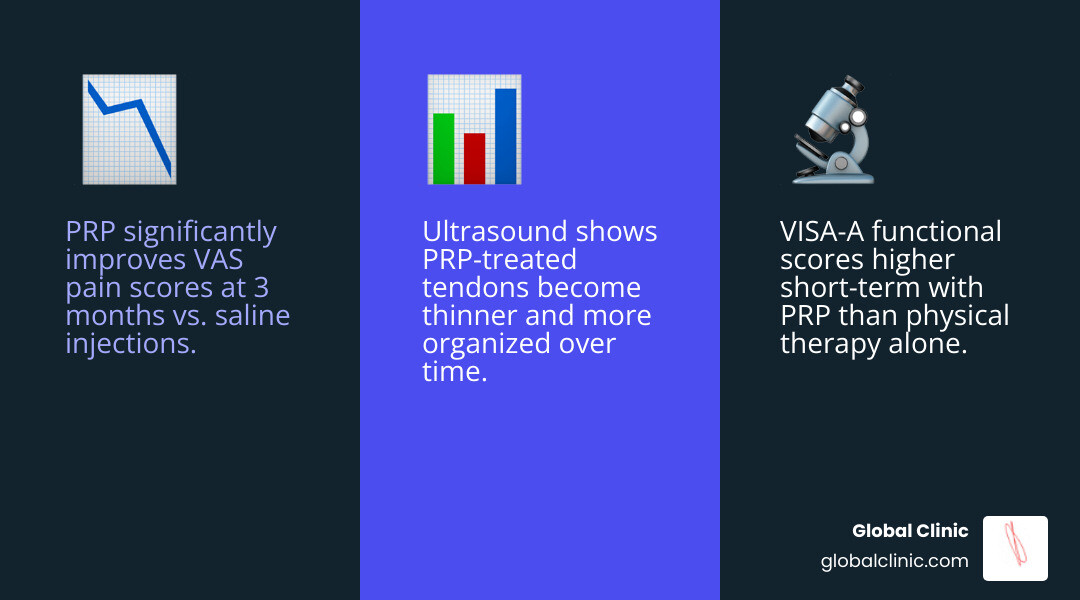
- Pain Relief (VAS Score): PRP shows a significant improvement in pain levels at the 3-month mark compared to salt-water (saline) injections.
- Function (VISA-A Score): This is a specific score for Achilles health. In many studies, the functional scores for PRP patients were better in the short term, though by the 6-to-12-month mark, many patients who did only physical therapy caught up.
- Tendon Structure: Some studies have used ultrasound to show that tendons treated with PRP actually become thinner and more organized over time, which is a sign of healing.
Statistical Outcomes for Tendinopathy
One of the most encouraging statistics from recent meta-analyses is that patients receiving PRP reported higher satisfaction rates at the 3-month mark. While it may not be a “magic bullet” that works instantly, for someone who has dealt with a “nagging” heel for a year, that 3-month window of improvement is a massive win.
The PRP for Achilles Tendon Procedure and Recovery
If you decide to move forward with us in our Arlington Heights or Mount Prospect locations, here is what a typical procedure day looks like. It’s a “lunch break” procedure, usually taking about 45 to 60 minutes in total.
- The Blood Draw: We take a small amount of blood, similar to a routine lab test.
- Centrifugation: Your blood is spun in a specialized centrifuge to isolate the “liquid gold”—the platelet-rich plasma.
- Preparation: We numb the area around your heel with a local anesthetic to make the process as comfortable as possible.
- Ultrasound-Guided Injection: This is the most important step. We use real-time ultrasound imaging to see exactly where the damage is inside your tendon. We then guide the needle to inject the PRP directly into those degenerated areas. This ensures the growth factors are delivered precisely where they can do the most good.
Recovery Timeline and Milestones
Recovery from PRP for Achilles tendon is a marathon, not a sprint. Because we are trying to rebuild tissue, you won’t feel better the next day. In fact, you might feel a bit more sore for 48-72 hours as the platelets “wake up” the inflammatory response.
- Days 0-3: Relative rest. We usually recommend a walking boot or a very supportive shoe. No high-impact activity.
- Weeks 1-3: Gentle range of motion and isometric exercises (holding a calf contraction without moving the joint).
- Weeks 3-6: Introduction of eccentric loading. This is the “gold standard” of Achilles rehab—slowly lowering your heel off the edge of a step.
- Weeks 6-12: Graded return to activity. You’ll start to notice that “morning stiffness” beginning to fade.
- 3-6 Months: Full return to sports, depending on the severity of the initial injury.
PRP’s Role in the Achilles Treatment Landscape
Why choose PRP over other options? In our 20 years serving Northern Chicago, we’ve seen how PRP fills a specific need.
- Beyond Symptomatic Relief: Cortisone injections are common for many joint issues, but we generally avoid cortisone for the Achilles. Why? Cortisone can actually weaken the tendon fibers and increase the risk of a full rupture. PRP does the opposite—it aims to strengthen the tissue.
- Addressing Limitations of Traditional Injections: Unlike saline (placebo) injections, which might provide a temporary “flushing” effect, PRP provides the actual biological machinery needed for repair.
- A Powerful Non-Surgical Option: Surgery for Achilles tendinopathy involves “debriding” or scraping the tendon. It has a long recovery and carries risks of infection. PRP offers a way to stimulate that same “clean up” process without a single scalpel.
- Enhancing Rehabilitation Outcomes: We view PRP as a “biologic boost.” It makes your physical therapy more effective. Think of PRP as the fertilizer and physical therapy as the sunlight—you really need both for the “plant” (your tendon) to grow back strong.
Frequently Asked Questions about Achilles PRP
How many injections are typically needed?
Most patients see significant improvement with just one high-quality, ultrasound-guided injection. However, for very chronic cases (symptoms for years), a second “booster” injection may be scheduled 6 to 8 weeks later. We rarely recommend more than three in a single year.
Is the procedure painful?
The initial numbing (local anesthetic) feels like a small pinch. During the PRP injection itself, you may feel a “fullness” or a dull ache in the heel. Most of our patients describe it as “uncomfortable but very manageable.” You will be able to walk out of the clinic on your own.
When can I return to sports?
This depends on your sport. For low-impact activities like swimming or cycling, you can often return within 3-4 weeks. For high-impact sports like running, basketball, or tennis, we usually look at a 6 to 12-week window to ensure the new collagen fibers are strong enough to handle the load.
Conclusion
At Global Clinic, we know that an Achilles injury doesn’t just hurt your heel—it hurts your quality of life. Whether you’re a runner in Palatine, a weekend warrior in Schaumburg, or someone in Des Plaines just trying to get through a workday without pain, you deserve a plan that works.
We’ve spent two decades refining our approach to pain management across Northern Chicago. By combining the latest in regenerative medicine—like PRP for Achilles tendon—with expert chiropractic care and physical therapy, we provide a truly personalized path to recovery. Our goal isn’t just to get you back on your feet; it’s to make sure your Achilles is stronger than it was before the injury.
If you’re tired of the “wait and see” approach and want to see if your Achilles is ready for a platelet boost, we are here to help.
Schedule a consultation at Global Clinic today and let’s get you back to the activities you love.