





Understanding Knee Anatomy and Common Causes of Joint Pain
Finding the right knee pain doctor depends on your specific symptoms, functional goals, and the underlying cause of joint discomfort. For non-surgical recovery, chronic joint pain, and biomechanical rehabilitation, an interventional physiatrist or sports medicine specialist provides targeted non-invasive therapies and joint injections. If you experience severe structural instability, acute mechanical locking, or advanced damage requiring surgical repair, an orthopedic surgeon is the appropriate specialist.
Understanding your knee anatomy makes it easier to pinpoint why discomfort occurs and what type of care will best resolve it. The knee is the largest and one of the most complex weight-bearing joints in the human body, functioning primarily as a modified hinge joint engineered to withstand immense forces while providing flexibility for walking, running, and climbing stairs.
The joint is formed by three primary bones:
- Femur (thighbone): The upper bone of the joint that transmits body weight down to the lower leg.
- Tibia (shinbone): The main weight-bearing bone of the lower leg, forming the base of the knee joint.
- Patella (kneecap): A specialized sesamoid bone that sits in front of the joint, gliding along the femoral groove to provide mechanical leverage for the quadriceps muscles and protect internal structures.
- Fibula: While not directly part of the hinge mechanism, this smaller lower-leg bone anchors crucial lateral stabilizing ligaments.
Protecting these bones are two distinct types of cartilage. Smooth articular cartilage caps the ends of the femur and tibia, allowing them to glide effortlessly against one another. Between these bones sit two crescent-shaped pads of fibrocartilage known as the medial and lateral menisci. The menisci distribute body weight evenly across the tibial plateau, act as shock absorbers during movement, and prevent excessive friction.
Joint stability relies on four primary ligaments:
- Anterior Cruciate Ligament (ACL): Prevents the tibia from sliding forward beneath the femur and controls rotational stability.
- Posterior Cruciate Ligament (PCL): Prevents the tibia from shifting backward relative to the thighbone.
- Medial Collateral Ligament (MCL): Stabilizes the inner aspect of the joint against outward forces.
- Lateral Collateral Ligament (LCL): Secures the outer aspect against inward forces.
When these structures suffer trauma or progressive wear, severe knee pain can emerge, ranging from sudden mechanical disruption caused by sports injuries to chronic joint degeneration.
| Condition Category | Primary Underlying Causes | Common Clinical Symptoms | Initial Diagnostic Approach |
|---|---|---|---|
| Acute Ligament Injury (e.g., ACL, MCL) | Sudden twisting, rapid deceleration, or direct impact trauma | Immediate joint “pop,” rapid swelling, instability, inability to bear weight | Physical stress tests (Lachman, Pivot Shift), Diagnostic MRI |
| Meniscal Tears | Acute rotational force or age-related tissue thinning | Joint catching, locking, localized joint-line tenderness, stiffness | McMurray’s test, Weight-bearing X-rays, MRI |
| Degenerative Osteoarthritis | Progressive articular cartilage wear and mechanical friction | Morning joint stiffness, dull aching, crepitus (grinding), decreased range | Standing radiographic imaging (X-ray), Ultrasound |
| Patellofemoral Syndrome | Muscle imbalance, improper tracking, or overuse | Anterior knee aching, sharp pain during deep squats or descending stairs | Biomechanical gait analysis, Functional muscle testing |
| Tendonitis & Bursitis | Repetitive loading, overuse, or poor kinetic alignment | Localized warmth, tenderness directly over tendons, swelling | Dynamic musculoskeletal ultrasound, Palpation |
Types of Specialists: What Knee Pain Doctor Should You See?
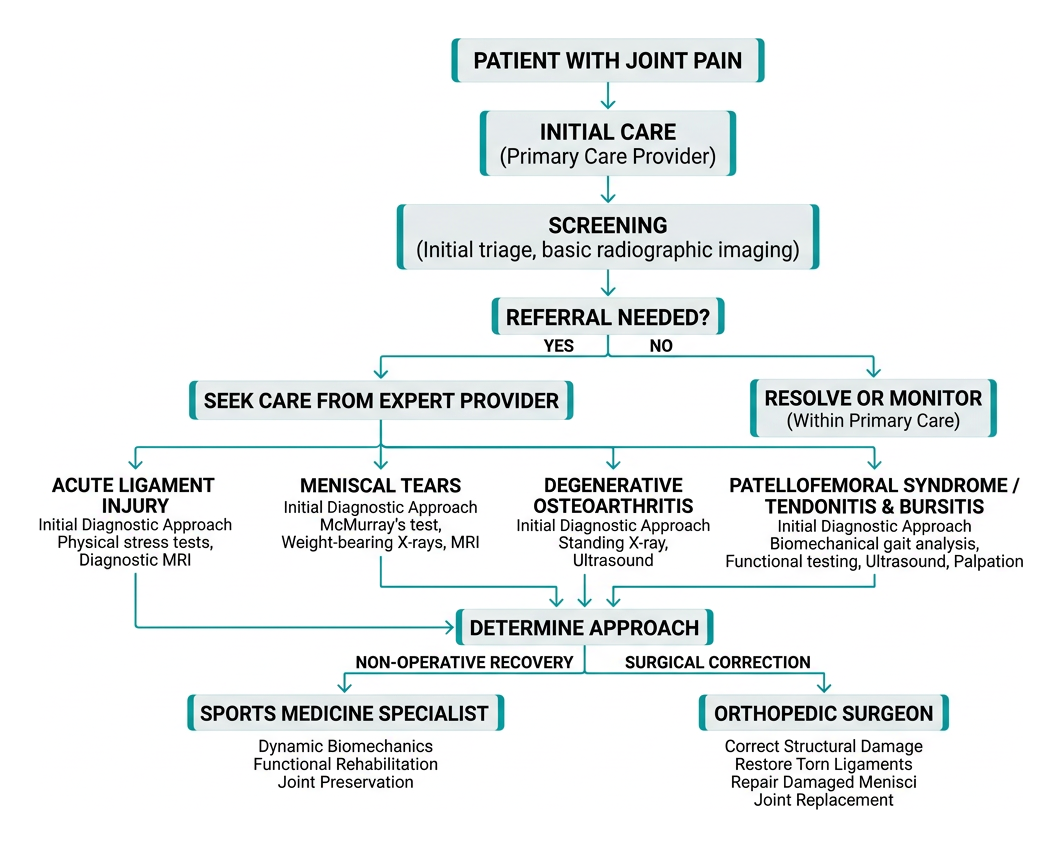
Navigating medical specialties can feel overwhelming when joint discomfort interrupts daily activities. The diagnostic pathway often begins with a primary care provider who conducts initial triage, orders basic radiographic imaging, and screens for systemic issues. However, when discomfort persists, limits functional mobility, or involves complex mechanical dysfunction, seeking care from an expert provider ensures targeted and efficient recovery.
Selecting the appropriate specialist depends largely on whether the issue stems from an acute structural tear, chronic joint degradation, or systemic inflammation, such as when managing arthritis and osteoarthritis.
Orthopedic Surgeons vs. Sports Medicine Specialists
Orthopedic surgeons are medical doctors (MD) or osteopaths (DO) who complete extensive surgical residency training, often followed by specialized fellowship training lasting 6 to 12 months. These clinicians specialize in correcting structural joint damage, restoring torn ligaments, repairing damaged menisci, and performing joint replacement procedures when natural structures can no longer be preserved.
Sports medicine specialists may come from orthopedic, physical medicine, or family medicine backgrounds, holding additional fellowship credentials in athletic injuries. Their practice centers around non-operative recovery, dynamic biomechanics, functional rehabilitation, and joint preservation. They treat athletes, active individuals, and everyday patients aiming to return to high-level physical performance without surgical intervention whenever possible.
Interventional Physiatrists and Rheumatologists
Physical Medicine and Rehabilitation (PM&R) physicians, also known as physiatrists, focus on restoring whole-body function, alignment, and mobility. Rather than viewing the knee in isolation, a physiatrist evaluates how the hips, spine, and feet influence knee mechanics. Physiatrists utilize conservative, evidence-based therapies and precision interventions to deliver comprehensive joint pain management.
Rheumatologists, by contrast, are internal medicine subspecialists who diagnose and manage autoimmune and systemic inflammatory conditions, such as rheumatoid arthritis, psoriatic arthritis, and gout. If joint swelling occurs across multiple joints simultaneously or is accompanied by systemic fatigue and unexplained inflammatory markers in bloodwork, a rheumatologist is essential for managing the underlying biochemical disease.
How to Choose the Right Specialist for Your Joint Condition
Choosing a knee specialist is an important step in regaining active mobility. Joint recovery works best as a collaborative process where the provider, rehabilitation team, and patient work together. When exploring a joint effort to end your knee and shoulder pain, prioritize clinics that emphasize thorough communication, transparent treatment options, and clear functional goals.
Choosing Between a Surgical and Non-Surgical Knee Pain Doctor
Surgery plays a vital role in addressing complete ligament ruptures, displaced cartilage fragments, or end-stage joint deterioration. However, many musculoskeletal conditions respond remarkably well to conservative management.
Beginning your diagnostic journey with a non-surgical specialist or physiatrist allows you to explore the best non-invasive methods for joint and back pain before considering operative interventions. Conservative-first protocols focus on reducing inflammation, strengthening dynamic stabilizers, and restoring natural biomechanics, reserving surgery for cases where structural stability cannot be achieved through non-invasive care.
Key Qualifications to Look for in a Knee Pain Doctor
When evaluating potential medical providers, consider the following credentials:
- Board Certification: Verifies rigorous clinical training and adherence to medical standards through accredited medical boards.
- Subspecialty Fellowship Training: Advanced training in sports medicine, interventional pain management, or joint reconstruction.
- Diagnostic Ultrasound Proficiency: Experience in using point-of-care ultrasound to evaluate soft tissues dynamically and ensure millimeter-level precision during joint procedures.
- Multidisciplinary Practice Model: Clinics that integrate physical therapy, chiropractic alignment, and medical pain management under one roof foster superior continuity of care.
- Patient Outcome Orientation: Clinicians who measure progress by functional recovery, pain reduction, and quality of life improvements.
How to Prepare for Your Specialist Consultation
Preparing thoroughly for your initial appointment helps your doctor develop an accurate diagnostic assessment:
- Document Your Symptom Timeline: Note precisely when the discomfort started, whether it was sudden or gradual, and what specific activities provoke or relieve it.
- Bring Previous Imaging Records: Bring physical discs or digital copies of past X-rays, CT scans, or MRIs rather than relying solely on written reports.
- Compile a Complete Medication List: List all prescription medications, over-the-counter anti-inflammatories, and joint supplements you currently take.
- Track Functional Limitations: Note concrete examples of daily tasks that cause difficulty, such as negotiating stairs, bending down, or walking specific distances.
- Prepare Relevant Questions: Write down questions regarding non-surgical alternatives, expected recovery timelines, and recommended activity modifications.
Non-Surgical Treatment Options for Lasting Knee Relief

Modern musculoskeletal medicine provides effective non-operative protocols designed to relieve discomfort, enhance stability, and restore mobility. Combining targeted medical interventions with structured functional rehabilitation allows patients across Niles, IL, Glenview, IL, and surrounding communities to address the root causes of their discomfort.
A comprehensive recovery plan typically begins with customized physical therapy. Targeted physical rehabilitation corrects strength imbalances in the quadriceps, hamstrings, and hip abductors, taking excess mechanical pressure off the knee joint. When persistent inflammation hinders rehabilitation progress, specialized joint injection therapy and regenerative joint therapy can help calm irritated tissues and support the body’s natural healing environment.
Targeted Injections and Advanced Biologics
Interventional treatments help bridge the gap between conservative therapy and surgery:
- Corticosteroid Injections: Powerful anti-inflammatory agents placed directly into the joint capsule to rapidly relieve severe swelling and acute pain flares.
- Hyaluronic Acid Viscosupplementation: Gel-like natural substances injected to restore fluid viscosity, improve internal lubrication, and cushion arthritic joint surfaces.
- Platelet-Rich Plasma (PRP): An orthobiologic approach utilizing concentrated platelets derived from the patient’s own blood. As explored in our guide on platelet-rich plasma, these preparations deliver concentrated growth factors to support tissue health.
- Specialized Biologic Protocols: Targeted options like therapeutic injections focus on managing localized inflammation, supporting cellular repair, and promoting long-term joint preservation.
When Is Surgery or Joint Replacement Truly Necessary?
While non-surgical care is often the first step, surgery may be necessary under certain clinical circumstances. Surgical consultation is generally recommended when:
- Advanced bone-on-bone arthritis fails to respond to injections, rehabilitation, and lifestyle modifications.
- Mechanical locking occurs due to a displaced bucket-handle meniscus tear or loose joint bodies.
- Complete ligament ruptures create persistent, unmanageable joint instability.
- Severe joint deformity prevents normal ambulation and significantly degrades quality of life.
Even when managing chronic wear, understanding options for living comfortably with knee arthritis helps patients make informed decisions alongside their care team.
Frequently Asked Questions About Knee Specialists
When should I see a specialist instead of waiting for knee pain to resolve?
You should schedule an evaluation with a specialist if you cannot bear weight on your leg, observe rapid joint swelling or visible deformity, or experience mechanical catching or locking. Furthermore, any persistent joint discomfort lasting longer than two to three weeks without improvement warrants professional diagnostic assessment to prevent secondary soft tissue strain.
What is the difference between a physiatrist and an orthopedic surgeon?
A physiatrist (PM&R physician) is a non-operative medical doctor who specializes in whole-body biomechanics, functional restoration, interventional injections, and physical rehabilitation. An orthopedic surgeon specializes in diagnosing structural issues and performing operative procedures such as arthroscopic repairs and total joint replacements, though many also oversee initial conservative management.
How do regenerative therapies like PRP help support joint health?
Regenerative modalities like PRP involve drawing a small sample of the patient’s blood, centrifuging it to isolate and concentrate platelets, and introducing those growth factors directly into the damaged joint environment under ultrasound guidance. These natural signaling proteins help modulate inflammation, support cellular health, and promote localized tissue recovery.
Conclusion
Overcoming joint discomfort and regaining smooth, pain-free mobility requires an accurate diagnosis and a personalized care plan. At Global Pain & Spine Clinic, our multidisciplinary team brings over 20 years of experience serving patients across Northern Chicago, including Niles, IL, Skokie, IL, Park Ridge, IL, Des Plaines, IL, Morton Grove, IL, and Mount Prospect, IL. By combining advanced pain management, physical therapy, chiropractic care, and innovative regenerative medicine, we focus on identifying the underlying cause of your symptoms to deliver lasting functional relief.
To learn more about evaluation and treatment options for persistent knee pain, contact our clinic today to speak with our specialists and schedule an appointment.