





Why PRP Injections for the Knee Are Changing Pain Management
Platelet-rich plasma (PRP) injection therapy for the knee is one of the most talked-about non-surgical options for chronic knee pain right now — and for good reason.
Here’s a quick snapshot of what you need to know:
| Question | Quick Answer |
|---|---|
| What is it? | A treatment using concentrated platelets from your own blood, injected into the knee |
| Who is it for? | Adults with knee osteoarthritis, tendon injuries, or meniscus tears |
| How effective is it? | Studies in knee osteoarthritis show meaningful improvement in pain and function for many patients |
| How long does it last? | Benefits typically last 6–12 months; some studies show effects up to 2 years |
| Is it safe? | Generally well tolerated — using your own blood minimizes rejection or allergic reaction risk |
| How many sessions? | Usually 2–3 injections spaced 2–3 weeks apart |
Knee pain is incredibly common. Whether it’s from osteoarthritis, a sports injury, or everyday wear and tear, it can stop you from doing the things you love. Most conventional treatments — like steroid shots or anti-inflammatory medications — only mask the pain temporarily. They don’t address the underlying tissue damage.
That’s where PRP therapy is different.
Instead of just managing symptoms, it works with your body’s own biology to stimulate healing at the source. It uses concentrated growth factors from your own blood — up to 5–10 times the concentration found in normal blood — to trigger tissue repair and reduce inflammation in the knee joint.
The science is still evolving, and results vary depending on the severity of the condition. But for many patients in Northern Chicago dealing with mild to moderate knee problems, PRP represents a meaningful step between conservative care and surgery.
I’m Anna Slavin, Practice Manager at Global Clinic, where our multidisciplinary team draws on over 20 years of global medical experience to help patients explore advanced, non-surgical solutions — including PRP knee injection therapy — as part of personalized pain management plans. We’re here to help you understand whether this treatment fits your situation, so let’s dig into everything you need to know.
Understanding PRP Injection Therapy for the Knee
To understand how PRP knee injection therapy works, we first need to look at what’s actually inside your blood. Your blood is a complex mixture of four primary components: plasma (the liquid part), red blood cells, white blood cells, and platelets.
While red blood cells carry oxygen, platelets are the “first responders” of the healing world. When you get a cut, platelets rush to the site to form a clot. But they do much more than just stop bleeding; they are packed with bioactive proteins and growth factors that act as a biological “SOS” signal, telling your body to start repairing damaged tissue.
PRP is an autologous therapy, which is a fancy way of saying it comes from your own body. By taking a small sample of your blood and concentrating the platelets, we create a powerful “healing cocktail” that can be injected directly into the knee joint. This concentrated dose of growth factors helps jump-start the repair process in areas that usually heal slowly, like cartilage and tendons.
According to the AAOS overview of PRP biology, these platelets contain growth factors that could help tissues repair themselves by causing new cells to form. At Global Clinic, we use this regenerative approach to help patients from across Northern Chicago find relief. You can find more info about treatments we offer to see how PRP fits into a broader pain management strategy.
How PRP Injections Work for Knee Osteoarthritis
When we talk about knee osteoarthritis (OA), we’re talking about a “wear and tear” condition where the protective cartilage in the joint breaks down. This leads to chronic inflammation, pain, and stiffness.
PRP knee injection therapy works on a molecular level to change the environment inside your knee. When the concentrated platelets are injected, they release growth factors like PDGF (Platelet-Derived Growth Factor) and TGF-beta. These proteins help:
- Reduce Inflammation: They inhibit the inflammatory cytokines that cause pain and swelling.
- Stimulate Repair: They encourage the migration of repair cells to the area.
- Improve Lubrication: Some studies suggest PRP can improve the quality of the synovial fluid (the joint’s natural lubricant).
Research on molecular mechanisms indicates that PRP may help reduce the chronic inflammation linked to knee OA while promoting a more “pro-healing” environment within the joint.
Preparation and Concentration Levels
The “secret sauce” of PRP is the concentration. For a therapeutic effect, we concentrate the platelets well above their normal level.
The preparation process is quick and efficient:
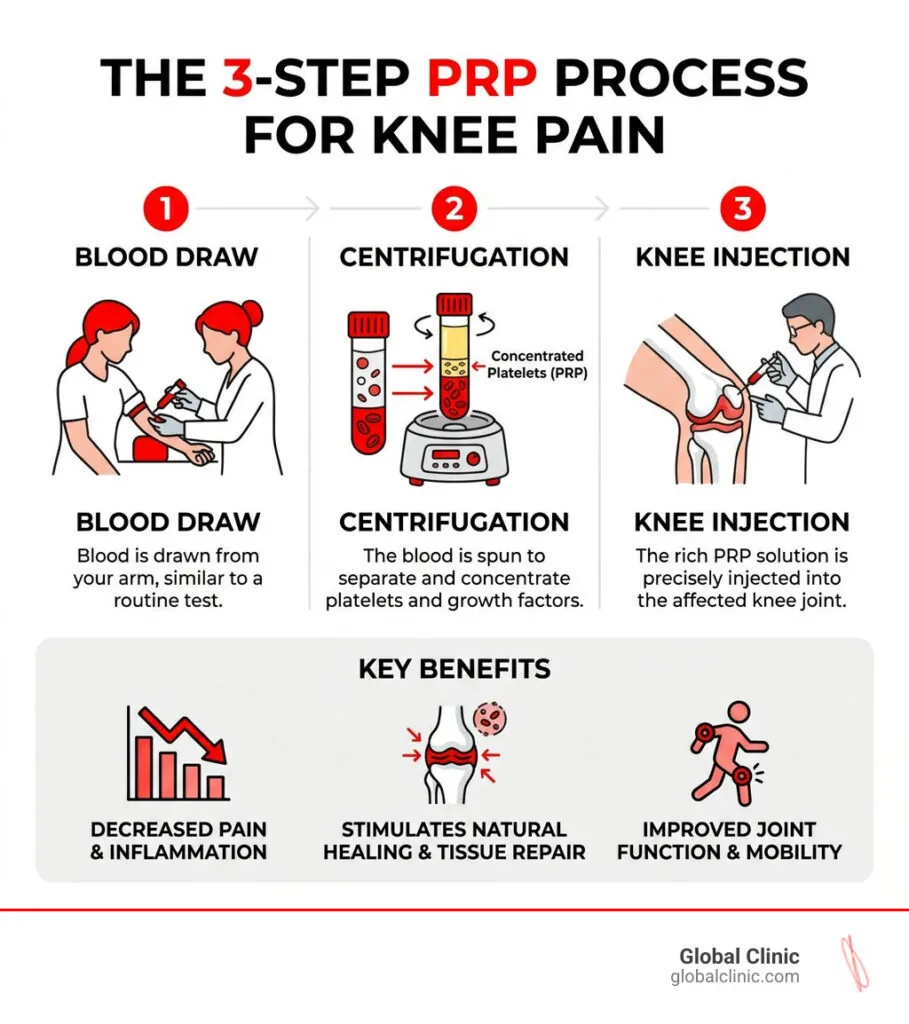
- Step 1: The Blood Draw. We draw about 10cc to 60ml of blood from your arm, similar to a standard blood test.
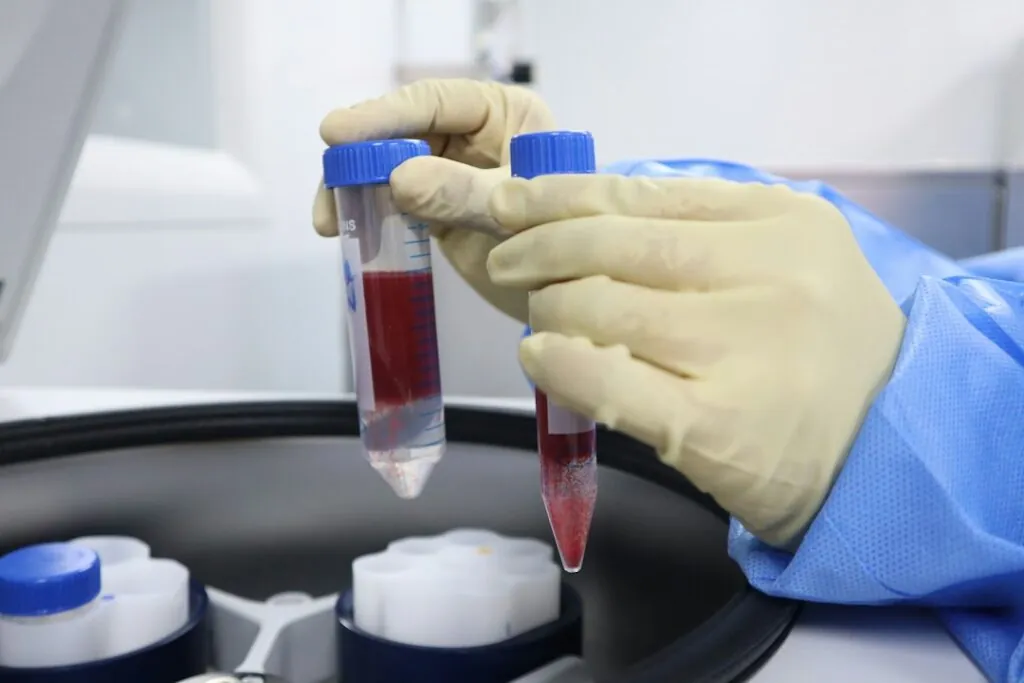
- Step 2: Centrifugation. The blood is placed in a centrifuge—a machine that spins at high speeds. This separates the blood components by density.
- Step 3: Concentration. We discard the red blood cells and keep the “buffy coat,” which contains a high concentration of platelets and plasma.
The final PRP product has a several-fold higher concentration of platelets and growth factors than whole blood. Depending on the condition, we may use “leukocyte-rich” PRP (which includes more white blood cells to stimulate a stronger healing response) or “leukocyte-poor” PRP (which is often preferred for joint injections to minimize post-injection flare-ups).
Clinical Effectiveness: What the Research Shows
Does it actually work? This is the question we hear most at our Niles clinic. The good news is that a growing body of scientific evidence supports the use of PRP knee injection therapy, especially for mild to moderate cases.
One of the most common ways researchers measure success is through the WOMAC (Western Ontario and McMaster Universities Osteoarthritis Index) score, which tracks pain, stiffness, and physical function.
- Significant Pain Reduction: A 2022 study of 153 participants found that at a 6-month follow-up, PRP significantly improved pain and stiffness scores.
- Functional Gains: A 2021 study involving 118 participants showed that symptoms improved over an average follow-up of nearly 52 months.
- Placebo Comparison: The Smith study (an RCT with 30 patients) showed that PRP reduced total WOMAC scores by 78% at 12 months, compared to just 7% for those who received a saline placebo.
According to a study on PRP vs saline placebo, patients receiving PRP showed significantly better clinical outcomes, suggesting that the benefits go far beyond a simple “placebo effect.”
Comparing PRP to Traditional Knee Treatments
When deciding on a treatment, it’s helpful to see how PRP stacks up against common alternatives like corticosteroids (steroids) or hyaluronic acid (HA).
| Feature | Corticosteroids | Hyaluronic Acid | PRP Injections |
|---|---|---|---|
| Primary Goal | Fast inflammation relief | Joint lubrication | Tissue repair/healing |
| Onset of Relief | Days (Very fast) | 2–4 weeks | 4–6 weeks |
| Duration | 1–2 months | 3–6 months | 6–12+ months |
| Cartilage Impact | May damage with repeat use | Neutral | May preserve/protect |
| Source | Synthetic | Synthetic or natural | Your own blood |
A 2020 review of treatment efficacy found that at 3, 6, and 12 months, PRP was generally more effective than steroids, HA, and placebos for managing knee OA symptoms. While steroids are great for immediate relief of a “hot,” swollen joint, they don’t offer the long-term biological benefits that PRP provides.
Success Rates and Long-term Outcomes
In the real world, success rates for PRP knee injection therapy are encouraging. A 2021 study found that PRP was successful roughly 60% of the time for knee osteoarthritis.
However, it is important to manage expectations. Research suggests that the benefits are most pronounced in the first 12 months. While some patients continue to feel great at the 24-month mark, others may find that the effects begin to taper off, requiring a “maintenance” injection to keep the pain at bay.
Subjective feedback from patients often highlights that while the pain doesn’t always vanish 100%, the quality of life improves significantly. Patients report being able to walk longer distances, climb stairs with less “grinding,” and reduce their reliance on daily painkillers.
The Procedure: What to Expect During Treatment
We know that needles can be intimidating, but the PRP procedure is straightforward and usually takes less than 45 minutes from start to finish.
At Global Clinic, we take care to deliver the PRP exactly where it needs to go, whether into the joint space or a specific tendon tear.
The Typical Protocol: Most clinical evidence supports a series of three injections, typically spaced 2 to 3 weeks apart. This “stacking” effect helps maintain a high concentration of growth factors in the knee during the critical early phases of the healing cascade.
Who Is a Candidate for PRP Knee Injections?
Not every knee is a candidate for PRP. We use the Kellgren-Lawrence grading system to determine the severity of your arthritis:
- Grade 1 & 2 (Mild): Excellent candidates. PRP may help relieve symptoms; evidence that it slows disease progression is limited.
- Grade 3 (Moderate): Good candidates. Many patients see a meaningful reduction in pain.
- Grade 4 (Severe/Bone-on-Bone): Limited success. At this stage, structural damage is often too severe for regenerative medicine alone, and surgery may be the more realistic option.
Other factors that influence your outcome include:
- BMI: Patients with a lower BMI tend to see better results, as there is less mechanical stress on the healing joint.
- Age: PRP can be used at any adult age, but younger patients with “acute” injuries (like a recent meniscus tear) often heal faster than older patients with chronic degeneration.
- Condition Type: Beyond OA, PRP may also help with patellar tendinitis (“Jumper’s Knee”), ligament sprains, and small meniscus tears.
A study on predictors of PRP success highlights that patient selection is key to achieving good results.
Potential Risks and Safety Profile
One of the biggest selling points of PRP knee injection therapy is its safety profile. Because the material is autologous, the risk of an allergic reaction or “rejection” is very low.
However, like any injection, there are minor risks:
- Temporary Pain/Stiffness: This is the most common side effect. Because we are “jump-starting” an inflammatory healing response, your knee might feel sore or full for 2–3 days after the shot.
- Infection: This is extremely rare (less than 1%) but a risk with any needle procedure. We use strict sterile techniques to prevent this.
- Nerve Damage: Also rare, especially with careful injection technique.
The AAOS safety overview notes that PRP doesn’t pose additional risks compared with more conventional treatment options. It is currently used “off-label” for knee OA, meaning that while the FDA clears the devices used to make PRP, they haven’t specifically “labeled” the procedure for arthritis—though it is widely accepted in the orthopedic community.
Recovery and Post-Injection Care
What you do after your injection is just as important as the injection itself. We want to protect that “healing cocktail” we just put into your knee.
The First 48-72 Hours:
- Rest: Avoid any strenuous activity. Walking around the house is fine, but no gym sessions or long hikes.
- Icing: If your provider recommends it, ice your knee for short periods. This helps manage the initial swelling without stopping the biological healing process.
- Pain Management: You may feel a “fullness” in the joint. This is normal.
The First 2 Weeks:
- Gradual Activity: You can return to light daily activities.
- Physical Therapy: We often recommend starting a gentle physical therapy program about 7–10 days post-injection. Strengthening the muscles around the knee (like the quads and hamstrings) helps take the pressure off the joint while the PRP works its magic.
The Importance of Avoiding NSAIDs
This is one of the most important instructions we give our patients: ask your provider before taking NSAIDs (Non-Steroidal Anti-Inflammatory Drugs) like Ibuprofen (Advil/Motrin) or Naproxen (Aleve) around the time of your injection.
Why? PRP works by causing a controlled amount of inflammation to trigger healing. NSAIDs work by stopping inflammation. Taking them can reduce the effect of the treatment.
- Timeline: Your provider will tell you how long to avoid NSAIDs before and after the procedure. If you take aspirin or other medications prescribed by your doctor, do not stop them without talking to your prescribing physician.
- Alternatives: If you need pain relief, ask your provider which option is appropriate for you.
Research on NSAIDs and PRP confirms that these medications can impair platelet function and reduce the release of those all-important growth factors.
Expected Timeline for Results
Patience is a virtue when it comes to regenerative medicine. Unlike a steroid shot, which can make you feel better in 48 hours, PRP knee injection therapy takes time.
- Phase 1 (Days 1–7): The “Inflammatory Phase.” You might actually feel a bit more sore. This is the growth factors waking up your body’s repair system.
- Phase 2 (Weeks 2–4): The “Proliferation Phase.” The soreness fades, and new tissue starts to form.
- Phase 3 (Weeks 6–12): The “Remodeling Phase.” This is when most patients start to notice a significant decrease in pain and an increase in mobility.
We typically perform a follow-up assessment at the 6-week mark to see how you’re progressing.
Frequently Asked Questions about PRP for Knees
Can PRP regenerate knee cartilage?
This is a point of much debate. While PRP can help reduce pain and improve function, imaging tests (like MRIs) have not conclusively proven that it can “regrow” a full layer of cartilage in a bone-on-bone knee.
What it can do is improve the health of the existing cartilage, reduce the inflammation of the synovial lining, and potentially slow down further degeneration. Think of it as “maintenance” for your joints rather than a “reset” button.
How many injections are typically required?
While some clinics offer a single injection, a study on multiple vs single injections suggests that a series of three injections provides superior long-term results compared to a single dose.
At Global Clinic, we personalize every treatment plan. If you have a very minor injury, one or two might suffice. For chronic osteoarthritis, a three-injection series spaced 2–3 weeks apart is a common approach supported by research.
Conclusion
If you’re tired of “managing” knee pain and want to start treating it, PRP knee injection therapy might be exactly what you’ve been looking for. By harnessing the power of your own blood, this therapy offers a minimally invasive way to reduce inflammation and promote healing.
At Global Clinic, we’re proud to be part of the Northern Chicago community. From our state-of-the-art facility, we provide personalized care to patients from Elk Grove Village to Lake Zurich and everywhere in between. Our goal isn’t just to mask your pain—it’s to get you back to the active lifestyle you deserve.
Ready to see if PRP is right for you? Whether you’re dealing with early-stage arthritis or a nagging sports injury, our team is here to help. Call Global Clinic in Niles at (847) 299-7000 to schedule your consultation.