







Why Plasma Rich Protein Injections for Hair Loss Are Getting So Much Attention
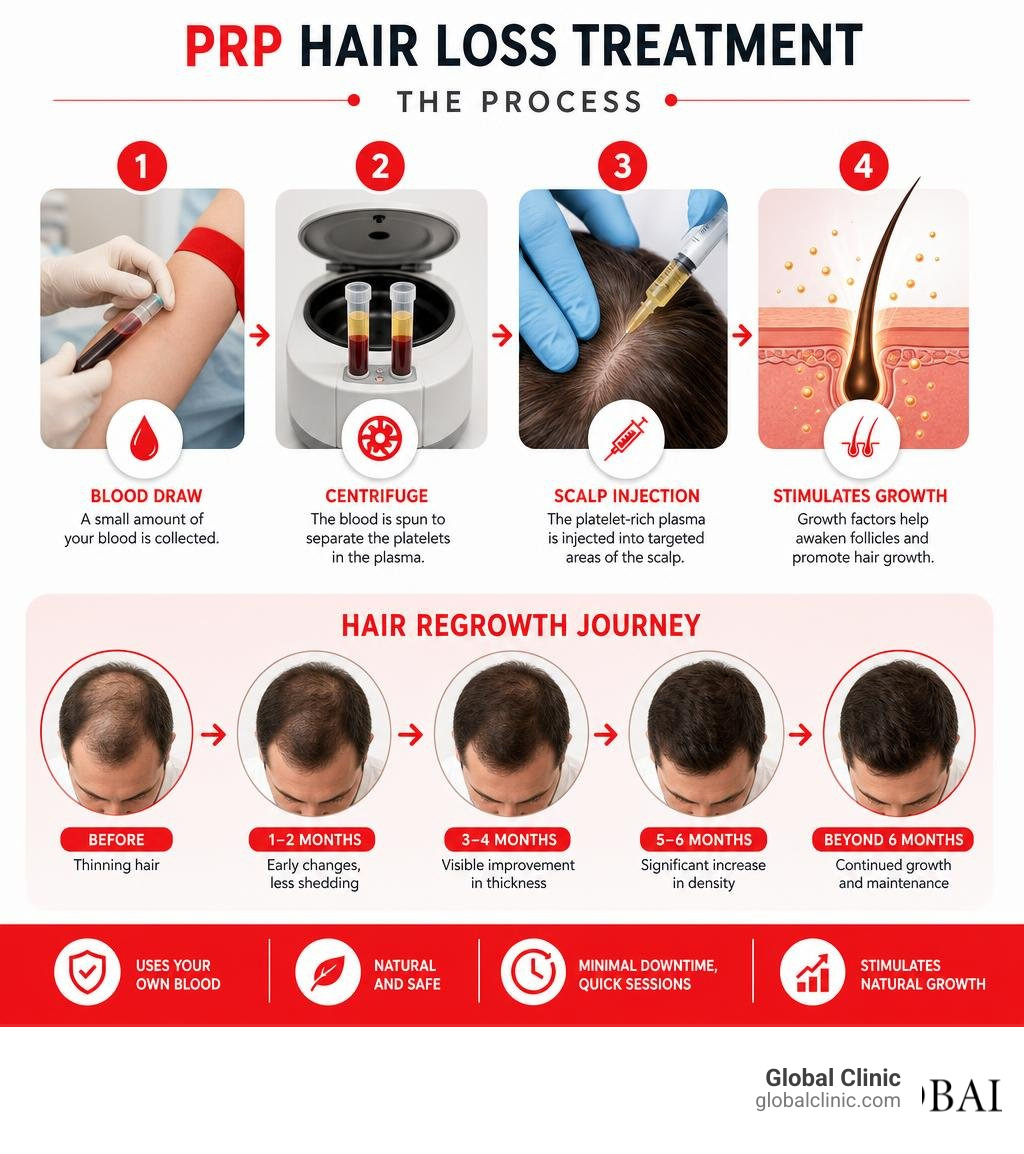
Plasma rich protein injections for hair loss — also called PRP therapy — work by drawing a small amount of your own blood, concentrating the platelets, and injecting that solution back into your scalp to stimulate hair follicles.
Here’s a quick overview of what PRP for hair loss involves:
| What You Want to Know | The Short Answer |
|---|---|
| What is it? | A scalp injection made from your own concentrated blood platelets |
| How does it work? | Growth factors in platelets stimulate dormant hair follicles |
| Who is it for? | People with thinning hair, not complete baldness |
| How many sessions? | Typically 3 monthly sessions, then maintenance every 6 months |
| When will I see results? | Early changes in 1–2 months; full results up to 6 months |
| Is it FDA-approved for hair? | No — it is currently off-label use |
| Is it safe? | Generally yes — it uses your own blood, so rejection risk is very low |
About 50 million men and 30 million women in the United States experience hereditary hair loss. That’s a lot of people searching for real answers — not just wigs or wishful thinking.
The good news? PRP therapy has real clinical evidence behind it. Studies show it can increase hair density by a meaningful margin, and at least 30–50% of patients experience measurable benefit.
But it’s not a magic fix. It works best for people who still have thinning hair — not areas that are already fully bald. And like any medical treatment, results vary from person to person.
I’m Ana Vinikov, Practice Manager at Global Clinic, where our multidisciplinary team has been delivering regenerative medicine treatments — including plasma rich protein injections for hair loss — to patients across the Northern Chicago area for over 20 years. In this guide, I’ll walk you through exactly how PRP works, what to expect, and whether it might be the right option for you.
Related content about plasma rich protein injections for hair loss:
Understanding Platelet-Rich Plasma (PRP) and How It Is Prepared
To truly understand how plasma rich protein injections for hair loss work, we first need to break down what platelet-rich plasma actually is. Your blood is primarily made of a liquid called plasma, which contains small solid components: red blood cells, white blood cells, and platelets.
Platelets are famous for their role in blood clotting, but they are also packed with hundreds of proteins called growth factors. These proteins are absolutely essential for healing injuries, regenerating tissue, and sustaining the life cycle of your cells. By concentrating these platelets, we create a solution that has a much higher concentration of growth factors than normal blood.
The PRP Preparation Process Step-by-Step
Creating platelet-rich plasma is a highly precise, multi-step process that we perform right in our state-of-the-art facilities in Niles, IL, and Chicago, IL. It takes about 30 minutes from start to finish.
- The Blood Draw: We begin by drawing a small amount of venous blood (typically between 10 to 60 mL) from your arm, much like a routine blood test.
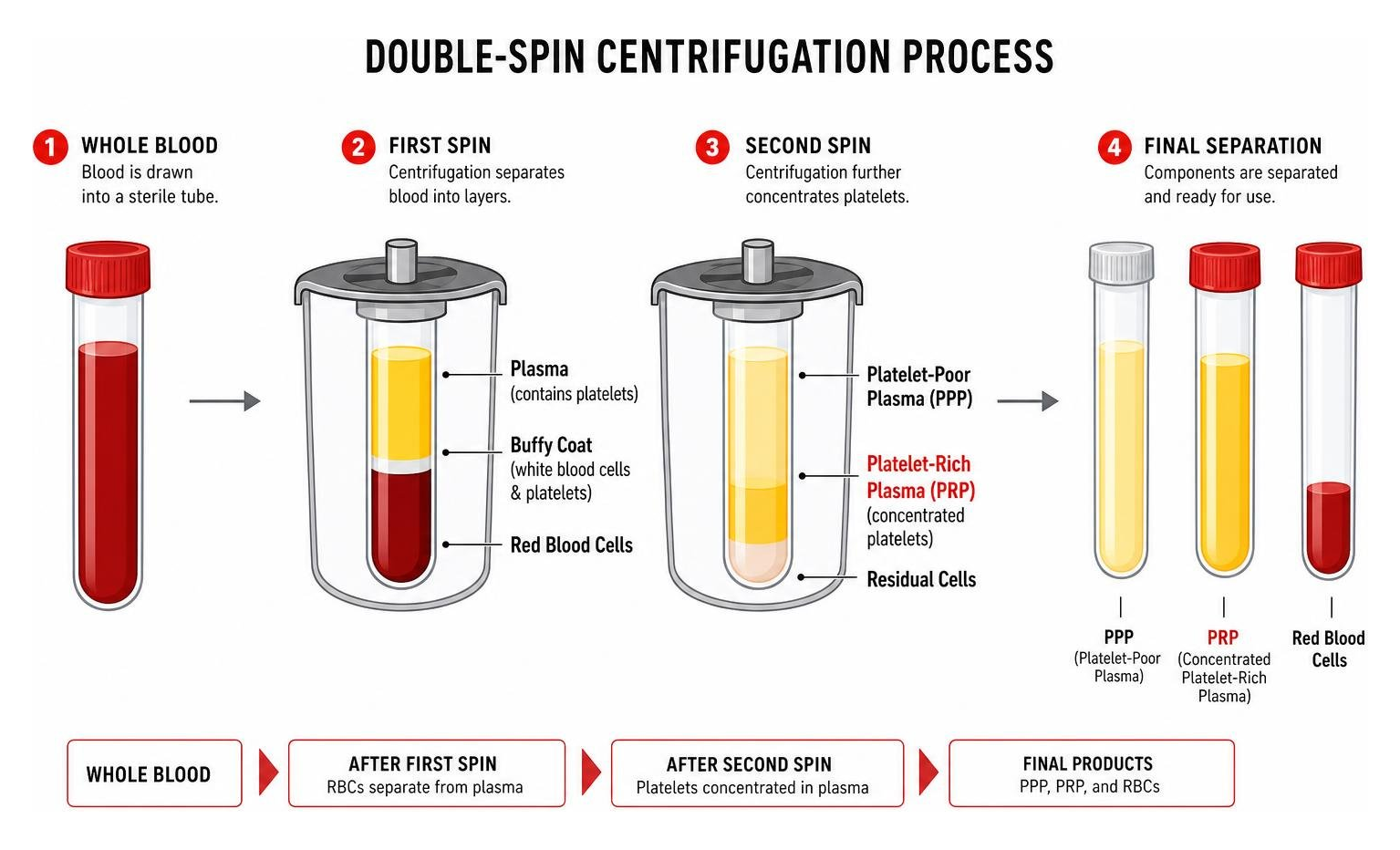
- Centrifugation (The Spin): The blood is placed into a specialized sterile tube and loaded into a machine called a centrifuge. This machine spins at incredibly high speeds to separate the blood components based on their density.
- The Double-Spin Method: Many clinical guidelines, including those discussed in academic reviews, advocate for a “double-spin” method. The first spin separates the red blood cells from the plasma. The second spin further concentrates the platelets in the plasma, separating the platelet-poor plasma (PPP) from the platelet-rich plasma (PRP). This allows us to achieve a platelet concentration that is 2 to 6 times higher than your baseline blood levels.
- Extraction and Injection: Once the pure, highly concentrated PRP is isolated, it is drawn into a syringe, ready to be strategically injected into the thinning areas of your scalp.
For a deeper dive into the science of blood processing, you can read about The Science Behind Blood Platelet Replacement Therapy or check out our comprehensive guide on Platelet Rich Plasma.
The Science Behind PRP: How It Promotes Hair Growth
Many patients ask us: how can a simple injection of my own blood make my hair grow back? The secret lies in the biological signaling that happens when concentrated platelets are introduced directly to the roots of your hair.
Your hair follicles go through a continuous cycle of growth (anagen), regression (catagen), and rest (telogen). In conditions like pattern baldness, the growth phase becomes shorter, and the follicles gradually shrink (miniaturize) until they produce only tiny, invisible hairs.
Growth Factors Involved in Hair Restoration
When we administer plasma rich protein injections for hair loss, the platelets are activated. They release their stored growth factors directly into the bulge area of the hair follicle. According to research published on PMC, several key growth factors drive this regenerative process:
- Vascular Endothelial Growth Factor (VEGF): Stimulates the growth of new blood vessels (angiogenesis) around the hair follicles, improving microcirculation and delivering vital oxygen and nutrients.
- Platelet-Derived Growth Factor (PDGF): Promotes cell growth, blood vessel formation, and skin regeneration.
- Epidermal Growth Factor (EGF): Stimulates cell proliferation and facilitates the hair growth cycle.
- Fibroblast Growth Factor-2 (FGF-2): Promotes the growth of dermal papilla cells, which are the control centers of hair follicles.
- Insulin-Like Growth Factor-1 (IGF-1): Keeps the hair follicle in its active growth (anagen) phase longer and delays the transition to the resting phase.
- Glial Cell Line-Derived Neurotrophic Factor (GDNF): Protects hair follicles from premature regression.
Cellular Signaling and Wnt/β-Catenin Activation
On a molecular level, PRP works by activating specific survival and growth pathways within the scalp. Most notably, it triggers Wnt/β-catenin signaling. This pathway is crucial because it directly counters the destructive, suppressive effects that dihydrotestosterone (DHT) has on hair follicles in individuals with genetic hair loss.
Furthermore, clinical studies show that PRP significantly increases Wnt/β-catenin expression and CD34 expression (a marker for vascular and progenitor cells). In fact, a study published in the Russian Military Medical Academy Journal demonstrated that PRP treatment led to an absolute increase in CD34 expression area of 287% and a relative increase of 325%, alongside a 165% absolute increase in β-catenin expression. This biological boost directly translates to improved microcirculation and highly active cell multiplication around the hair roots.
To read more about how we harness these biological mechanisms, explore our guide on Your Guide To Quality Platelet Rich Plasma Injection Services.
What Types of Hair Loss Can PRP Treat?
While PRP is highly versatile, it is not a one-size-fits-all cure. Its effectiveness depends heavily on the underlying cause of your hair loss.
Androgenetic Alopecia (Pattern Baldness)
This is the most common form of hair loss, affecting both men (male pattern baldness) and women (female pattern hair loss). It is characterized by progressive thinning, typically in a M-shaped pattern or along the crown in men, and a widening part line in women. PRP is highly effective for androgenetic alopecia because it rejuvenates miniaturized follicles, encouraging them to produce thicker, stronger terminal hairs.
Alopecia Areata
Alopecia areata is an autoimmune condition where the body’s immune system mistakenly attacks the hair follicles, causing patchy hair loss. Clinical evidence suggests that the anti-inflammatory properties of PRP can help calm this local immune response. Some studies have shown that PRP can successfully trigger regrowth in patients with corticosteroid-resistant alopecia areata, sometimes even yielding better results when combined with conventional treatments.
Cicatricial (Scarring) Alopecia
Cicatricial alopecia refers to a group of rare disorders that destroy hair follicles and replace them with scar tissue, resulting in permanent hair loss. Because PRP relies on living hair follicles to work, it cannot regrow hair in areas that have already scarred over. However, limited case reports suggest that PRP may help reduce inflammation and halt the progression of active scarring in conditions like frontal fibrosing alopecia or lichen planopilaris.
To learn more about natural approaches to hair restoration, read our article: The Mane Event For Natural Hair Growth.
Clinical Evidence: What Do the Studies Say?
Is there actual science backing up plasma rich protein injections for hair loss? Absolutely. Over the last decade, numerous randomized controlled trials (RCTs) and systematic reviews have evaluated the efficacy of PRP.
Key Statistical Outcomes on Hair Density and Diameter
The clinical data paints a very encouraging picture for those struggling with thinning hair:
- Significant Hair Density Increases: A systematic review and meta-analysis of multiple clinical studies found that PRP treatments resulted in a significant increase in hair density compared to control groups, showing a mean difference of 17.90 hairs per cm² (95% CI 5.84–29.95, P=0.004).
- Substantial Improvements in Men: In male patients with androgenetic alopecia, meta-analyses have shown a mean difference increase of 25.83 hairs per cm² and a significant increase in hair diameter (MD 6.66 μm, 95% CI 2.37–10.95, P=0.002).
- Objective AI and Microscopic Verification: In a randomized, placebo-controlled split-scalp study, researchers used AI-based trichoscopy to measure results. They found that hair density increased by 8.4% after 3 sessions and by 19.1% after 6 months on the side treated with PRP, while the placebo side (treated with saline) showed no improvement. Furthermore, the proportion of single-hair follicular units decreased from 58.4% to 43.9%, while multiple-hair follicular units (which give hair its full, dense appearance) increased from 19% to 35%.
Non-Activated vs. Activated PRP Efficacy
An interesting debate in the medical community is whether PRP should be “activated” with chemicals like calcium chloride or bovine thrombin before injection.
Interestingly, research compiled by the National Institutes of Health (PMC) suggests that non-activated PRP actually yields superior results for hair regrowth. Non-activated PRP relies on the body’s natural collagen to activate the platelets slowly. This leads to a gradual, sustained release of growth factors over a period of up to 10 days, compared to a rapid, one-hour spike seen with chemical activation.
In clinical trials, non-activated PRP achieved a 31% ± 2% increase in hair density, compared to just 19% ± 3% for chemically activated PRP. At Global Clinic, we stay at the forefront of this clinical research to ensure we utilize the most effective preparation protocols for our patients in Niles, IL, and Glenview, IL.
Standard PRP Treatment Protocols and What to Expect
If you decide to move forward with PRP therapy, consistency is key. Because hair grows slowly (about 0.3 mm per day), this treatment requires a structured schedule to align with your hair’s natural growth cycles.
Session Frequency and Maintenance Schedules
A standard, clinically proven PRP treatment program consists of two main phases:
- The Loading Phase: You will receive one session every month for three consecutive months (a total of 3 sessions). This initial phase “wakes up” dormant follicles and transitions them into the active growth phase.
- The Maintenance Phase: To sustain your results, you will need booster sessions. The most common protocol is a booster session every six months. Some patients with more aggressive hair loss may benefit from a session every three to four months.
If you stop PRP treatments completely, your hair will eventually return to its pre-treatment state over time, as the genetic and hormonal factors causing your hair loss will continue to affect your follicles.
Post-Treatment Care Guidelines
One of the greatest benefits of plasma rich protein injections for hair loss is that there is virtually no downtime. You can drive yourself home and return to work immediately after your session. However, to get the absolute best results, we recommend following these simple post-care steps:
- Be Gentle with Your Hair: You can gently style your hair immediately after the procedure. However, wait until the following morning to wash your hair, and use a gentle, sulfate-free shampoo.
- Avoid Harsh Chemicals: Avoid hair coloring, perms, or chemical treatments for at least 48 to 72 hours after your injections.
- Take a Break from the Gym: You can engage in light exercise the day after your session, but avoid strenuous workouts, heavy sweating, or saunas for at least two days.
- Manage Discomfort Safely: It is common to experience mild soreness or a “tight” feeling in your scalp for a day or two. If needed, use acetaminophen (Tylenol) for pain relief. Avoid anti-inflammatory medications (NSAIDs) like ibuprofen, Advil, or aspirin for up to 14 days post-procedure, as these medications can interfere with the natural inflammatory process that makes PRP work!
For more information on the injection process and general recovery, you can read our page on Injection For Platelets.
How PRP Compares to Other Hair Loss Treatments
When navigating hair loss, it is helpful to understand how PRP stacks up against more traditional therapies.
PRP vs. Topical Minoxidil and Oral Finasteride
Topical minoxidil (Rogaine) and oral finasteride (Propecia) are the traditional first-line treatments for pattern baldness.
| Feature | PRP Injections | Topical Minoxidil | Oral Finasteride (Men Only) |
|---|---|---|---|
| How it’s taken | In-office micro-injections | Daily topical application | Daily oral pill |
| Primary action | Delivers growth factors & improves microcirculation | Widens blood vessels | Blocks DHT hormone production |
| Side effects | Mild localized soreness, temporary swelling | Scalp irritation, unwanted facial hair growth | Sexual side effects, mood changes |
| Compliance | High (completed in a few yearly visits) | Low (must be applied twice daily forever) | Moderate (must remember a daily pill) |
Many patients prefer PRP because it is entirely natural and does not carry the risk of systemic side effects (such as the hormonal or sexual side effects sometimes associated with finasteride). In clinical practice, we often find that the most dramatic results occur when patients combine PRP with these traditional therapies, creating a highly effective, multi-angled approach to hair restoration.
PRP vs. Hair Transplantation
A hair transplant is a surgical procedure where hair follicles are physically moved from an area of dense growth (usually the back of the head) to the balding areas.
While a hair transplant is the ultimate solution for filling in completely bald patches, it is invasive, requires surgical recovery, and relies on having enough healthy donor hair. PRP cannot create new hair follicles where they have completely died, but it is an exceptional, non-surgical option for thickening up areas of active thinning.
Furthermore, many hair transplant surgeons use PRP in tandem with surgery. Injecting PRP into the scalp during or after a transplant can significantly accelerate healing, reduce graft shedding, and help the newly transplanted follicles take root and grow stronger, faster.
Risks, Side Effects, and Contraindications
Because platelet-rich plasma is autologous — meaning it is derived entirely from your own blood — it is incredibly safe. There is virtually zero risk of an allergic reaction, foreign-body rejection, or contracting a blood-borne disease.
Common Side Effects and Safety Profile
The side effects of PRP are mild, localized, and typically resolve within 24 to 48 hours. They include:
- Mild pain or tenderness at the injection sites
- Temporary redness or localized swelling on the scalp
- Minor bruising or pinpoint bleeding
- A mild headache or feeling of pressure in the scalp immediately following the procedure
Absolute and Relative Contraindications
While PRP is incredibly safe for the vast majority of people, it is not suitable for everyone.
Absolute Contraindications (Who should NOT get PRP):
- Severe thrombocytopenia (very low platelet count)
- Platelet dysfunction syndromes or clotting disorders
- Hemodynamic instability or sepsis
- Active infections or skin cancers on the scalp
Relative Contraindications (Who should proceed with caution):
- Chronic liver disease
- Heavy smokers or heavy alcohol users (as tobacco and alcohol can significantly impair platelet function and reduce the concentration of growth factors)
- Those currently taking blood-thinning medications (anticoagulants)
- Individuals with unstable thyroid disease or autoimmune conditions like lupus, as these underlying conditions can cause hair loss that PRP cannot easily resolve without systemic medical management
To learn more about the broader safety and pain-management aspects of PRP, explore our Prp Pain Management Ultimate Guide.
FDA Status and Medical Authority
A common point of confusion for patients is whether PRP is FDA-approved.
What Does ‘Off-Label’ Use Mean?
To clarify: the FDA does not approve procedures like PRP; instead, it approves the devices used to perform them. The centrifuge machines and specialized tubes we use to isolate PRP are fully FDA-cleared for processing blood.
Using PRP to treat hair loss is considered an “off-label” use. In the medical field, off-label use is incredibly common and entirely legal. It simply means that while the technology is cleared for safety, the FDA has not officially run its own multi-million-dollar clinical trials specifically for the indication of hair loss. Doctors across the globe routinely prescribe and perform off-label treatments when there is robust, peer-reviewed clinical evidence proving their safety and efficacy.
For more information on finding a qualified clinical provider, take a look at our Prp Injections Near Me Guide.
Who is the Ideal Candidate for PRP?
If you are considering plasma rich protein injections for hair loss, the most important factor in your success is timing.
Predictors of Treatment Success
You are an ideal candidate for PRP if:
- You are in the early stages of hair thinning: PRP works by reviving weak, miniaturized hair follicles. If a hair follicle has been completely inactive or bald for several years, it becomes fibrotic (scarred over), and PRP will not be able to bring it back to life.
- You have active hair follicles: Patients with diffuse thinning across the scalp or a widening part line generally see the most satisfying results.
- You are in good general health: Because the treatment relies on the quality of your own blood, individuals with healthy platelet counts, balanced diets, and low stress levels tend to respond best.
- You have realistic expectations: PRP is designed to increase hair density, reduce shedding, and thicken existing strands. It is not a surgical hair transplant, and it requires ongoing maintenance to keep your results.
Regenerative Medicine at Global Clinic: Serving Northern Chicago
At Global Clinic, we believe that the best healthcare is personalized, multidisciplinary, and backed by cutting-edge science. For over 20 years, our team of experienced medical professionals has been providing advanced pain management, physical therapy, chiropractic care, and state-of-the-art regenerative medicine to communities across Northern Chicago.
We proudly serve patients throughout our local service areas, including:
- Niles, IL
- Skokie, IL
- Glenview, IL
- Park Ridge, IL
- Morton Grove, IL
- Des Plaines, IL
- Mount Prospect, IL
- Chicago, IL (and surrounding Northern suburbs)
Whether you are looking to restore your hair, recover from a sports injury, or find lasting relief from chronic pain, our state-of-the-art facilities are equipped to deliver the highest standard of care.
If you are ready to take control of your hair loss and explore how plasma rich protein injections for hair loss can help you regain your confidence, we invite you to take the next step.
Schedule an appointment with our specialists today to discuss your personalized treatment options. We look forward to helping you feel and look your absolute best!