








When Pain Won’t Go Away: What You Need to Know About Interventional Pain Management
Interventional pain management is a specialized area of medicine that uses minimally invasive, targeted procedures — such as nerve blocks, epidural injections, and radiofrequency ablation — to diagnose and treat pain at its source, rather than masking it with medication.
Quick answer: What is interventional pain management?
| Question | Answer |
|---|---|
| What is it? | A medical specialty using targeted, minimally invasive procedures to treat chronic and acute pain |
| Who is it for? | People whose pain hasn’t improved with medication or physical therapy alone |
| Common procedures | Epidural steroid injections, nerve blocks, radiofrequency ablation, spinal cord stimulation |
| How it’s different | Treats the root cause — not just the symptoms |
| When to consider it | After 6 weeks of conservative care with little or no relief |
| Is it covered by insurance? | Often yes, if deemed medically necessary — verify with your provider |
Here’s a sobering reality: more than 20% of adults in the United States live with chronic pain, and 70% of us will experience it at some point in our lives. For many people in the Northern Chicago area — from Niles and Skokie to Park Ridge and Des Plaines — that pain becomes a daily barrier to work, family life, and the activities they love.
The good news? You don’t have to choose between living with pain and undergoing major surgery. Interventional pain management sits in a powerful middle ground — offering precise, evidence-based relief that goes far beyond what a pill can do.
I’m Anna Slavin, Practice Manager at Global Pain & Spine Clinic, where our multidisciplinary team has spent over 20 years helping patients across the Northern Chicago suburbs find lasting relief through interventional pain management and comprehensive rehabilitative care. In this guide, I’ll walk you through exactly how these treatments work, what to expect, and how to decide if they’re right for you.
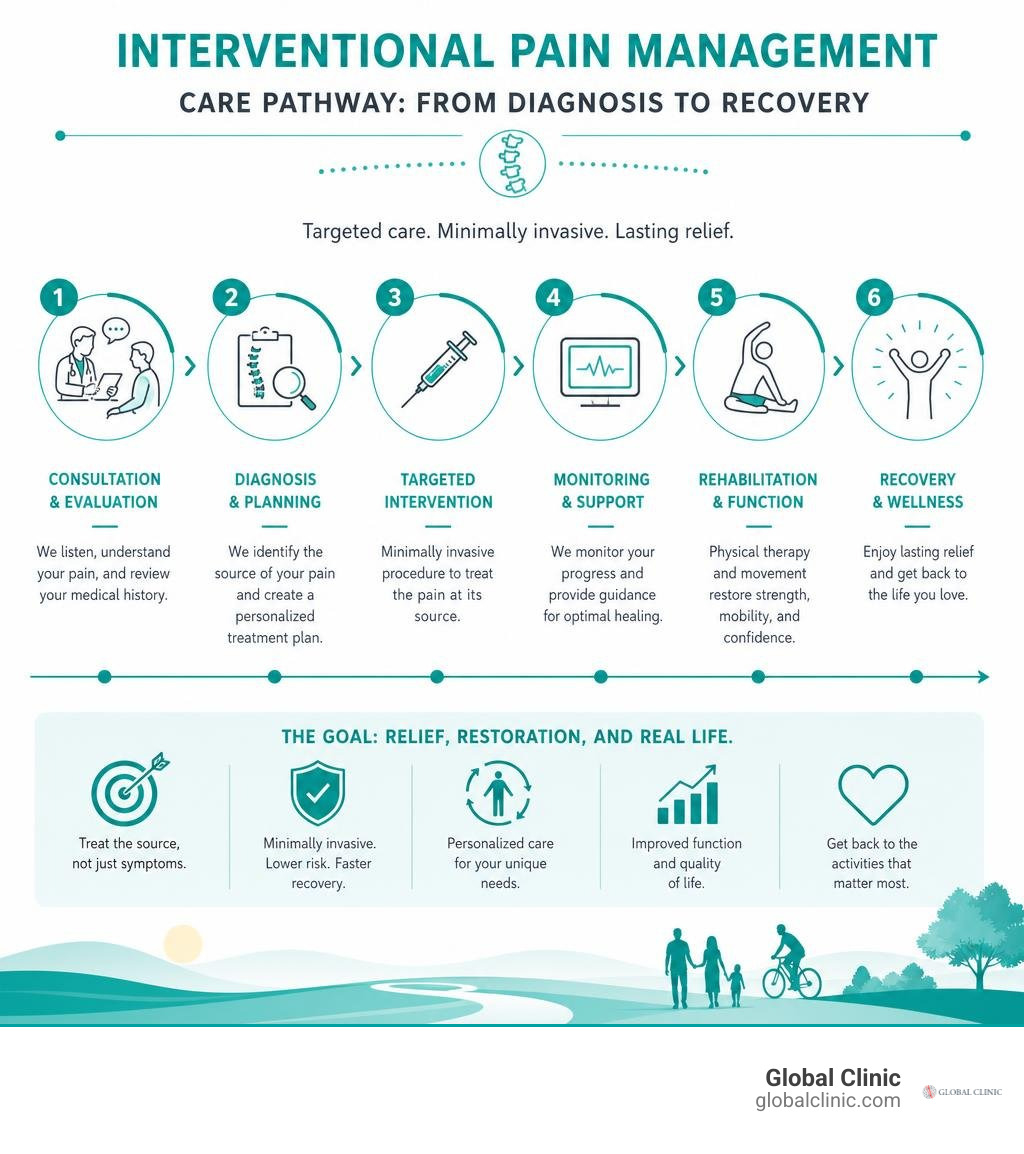
Quick interventional pain management definitions:
What is Interventional Pain Management?

At its core, interventional pain management is a specialized discipline of medicine focused on diagnosing and treating pain-related disorders. While traditional pain medicine often relies on oral drugs to quiet down the nervous system, we use precise, minimally invasive techniques to target the exact anatomical structure causing your discomfort.
What makes this subspecialty so unique is its dual nature: these procedures are both diagnostic and therapeutic. If we suspect a specific tiny joint in your spine is the culprit behind your lower back pain, we can perform a highly targeted injection at that exact spot. If your pain vanishes temporarily, we have successfully diagnosed the root cause. We can then apply a longer-lasting therapeutic treatment to that same area.
By focusing on the root anatomical cause of pain—whether it is an inflamed nerve root, a degenerated joint, or a damaged disc—we help patients break the cycle of chronic pain. If you want to learn more about how specialized clinics operate, you can explore what are pain management clinics to see how these services are structured to support your recovery.
How It Differs from Traditional Pain Management
To understand the power of the interventional approach, it helps to compare it to traditional methods. When you visit a standard medical clinic for chronic back or neck pain, the conventional toolkit often consists of oral anti-inflammatories, muscle relaxers, or prescription opioids.
While oral medications have their place, they are systemic. This means when you swallow a pill, the drug circulates through your entire bloodstream, affecting your stomach, liver, brain, and other organs, with only a fraction of the medication actually reaching the painful spot in your spine. This systemic path often brings unwanted side effects like brain fog, drowsiness, gastrointestinal distress, and the risk of physical dependency.
By contrast, we emphasize localized treatment. Instead of sending a drug through your entire body, we use specialized tools to deliver targeted relief directly to the painful tissue. This localized focus is a cornerstone of effective pain management, allowing us to reduce or entirely eliminate a patient’s reliance on oral medications, particularly habit-forming opioids.
The Role of Advanced Imaging Guidance
You might wonder: how do we ensure the medication goes exactly where it needs to, especially when dealing with tiny nerves deep inside the body? The answer lies in advanced imaging guidance.
We never perform spinal or deep joint interventions “blindly.” Instead, we utilize state-of-the-art imaging technologies to navigate with millimeter-level precision:
- Fluoroscopy: This is a specialized, real-time X-ray video that allows our physicians to view the internal structures of your skeleton on a digital screen. By watching the needle’s path in real time, we can safely guide it directly to the target area while completely avoiding critical blood vessels and surrounding nerves.
- Ultrasound Guidance: For soft tissue treatments, peripheral nerve blocks, and joint injections, high-resolution ultrasound provides exceptional real-time imaging of muscles, tendons, ligaments, and nerves without any radiation exposure.
These imaging technologies are vital for safety. By verifying the exact position of our instruments before administering any therapeutic agents, we maximize the effectiveness of the treatment while keeping risks to an absolute minimum.
Common Minimally Invasive Procedures

All our advanced interventional procedures are performed in a sterile, state-of-the-art outpatient setting right here in our Niles, IL facility. This means you can receive highly advanced care and return home the very same day to recover in the comfort of your own house. If you are curious about the full range of options we offer, you can explore our complete list of pain management procedures.
Epidural Steroid Injections and Nerve Blocks
Among the most common and effective tools in our arsenal are epidural injections and targeted nerve blocks. These procedures are designed to calm down highly irritated nerves that send urgent pain signals to your brain.
- Epidural Steroid Injections (ESIs): If you suffer from a herniated disc, spinal stenosis, or sciatica, you know how debilitating radiating leg or arm pain can be. During an ESI, we deliver a potent anti-inflammatory corticosteroid directly into the epidural space—the area surrounding your spinal cord and nerve roots. This directly bathes the inflamed nerves in medicine, dramatically reducing swelling and relieving radiating pain. You can read more in-depth details about epidural injections and how they are administered.
- Facet Joint Injections: Your spine is held together by small, hinge-like joints called facet joints. Just like knees or hips, these joints can develop wear-and-tear arthritis, leading to localized aching in the back or neck that worsens when you bend backward. A targeted facet injection delivers a soothing mixture of anesthetic and anti-inflammatory medication directly into the arthritic joint to quiet the pain.
- Selective Nerve Blocks: These injections target a specific nerve root exiting the spine. They are incredibly useful for identifying exactly which nerve is compressed or irritated, while providing rapid, localized relief.
These injections are highly supported by clinical literature. For example, scientific research on spinal injection efficacy shows that targeted epidural injections can significantly reduce disability and pain scores over the long term, helping patients avoid invasive surgeries.
Radiofrequency Ablation (RFA) and Neuromodulation
For patients seeking longer-lasting relief from chronic joint pain or spinal arthritis, we offer advanced treatments that temporarily interrupt the nerve’s ability to transmit pain signals.
- Radiofrequency Ablation (RFA): If a patient experiences excellent, but temporary, relief from a diagnostic nerve block, they may be an ideal candidate for RFA. Using fluoroscopic guidance, we insert a specialized needle near the tiny sensory nerves (medial branches) of the painful joint. The tip of the needle is heated using radiofrequency energy, which gently creates a small, precise lesion on the nerve. This “turns off” the nerve’s ability to send pain signals to the brain. Because the nerve is interrupted, relief can last for several months or even over a year. Over time, the nerve will slowly regenerate, but the procedure can be safely repeated if the pain returns. Learn more about how this works by reading about radiofrequency ablation rfa.
- Spinal Cord Stimulation (SCS): For complex, chronic nerve pain that has not responded to other treatments, neuromodulation can be a life-changing option. A spinal cord stimulator is a small device implanted under the skin that sends mild, soothing electrical pulses to the spinal cord. These pulses interfere with and mask the pain signals before they can reach your brain, replacing sharp pain with a gentle, often imperceptible sensation.
| Feature | Radiofrequency Ablation (RFA) | Spinal Cord Stimulation (SCS) |
|---|---|---|
| Primary Target | Sensory nerves of arthritic joints (spine, knees) | Spinal cord pathways for chronic nerve pain |
| How It Works | Uses heat to temporarily disable pain-transmitting nerves | Uses electrical currents to mask pain signals |
| Duration of Relief | Typically 6 to 18 months | Long-term (device can last 2 to 10+ years) |
| Invasiveness | Minimally invasive needle procedure | Minor outpatient implant procedure (with a trial phase) |
| Nerve Regeneration | Yes, nerves typically regenerate in 9 to 18 months | N/A (signal is continuously managed by the device) |
Conditions Treated and When to Seek Specialist Care
Because interventional pain management targets the nervous and musculoskeletal systems, it can address a wide variety of painful conditions. We frequently treat patients suffering from:
- Chronic lower back pain and neck pain
- Herniated, bulging, or degenerated discs
- Sciatica and radiating leg pain (radiculopathy)
- Osteoarthritis of the knees, hips, and shoulders
- Spinal stenosis (narrowing of the spinal canal)
- Complex Regional Pain Syndrome (CRPS)
- Post-surgical back pain (failed back surgery syndrome)
- Chronic tension headaches and migraines
When to See an Interventional Pain Management Specialist
If you are dealing with a brand-new, acute injury, standard conservative care is usually the best starting point. This includes resting, applying ice or heat, and participating in physical therapy or chiropractic care. However, if you have reached the six-week mark of conservative treatment and are still experiencing significant pain, it is time to consult a specialist.
Taking action before pain becomes deeply chronic is incredibly important. When pain goes untreated for months, your nervous system can become “sensitized,” meaning it actually rewrites its pathways to amplify pain signals, making the condition harder to treat down the road.
If you are ready to take the next step and want to find professional care close to home in Niles, Skokie, Glenview, or the surrounding suburbs, you can search for pain clinics near me or look up pain clinics in my area to connect with our team.
Integrating Regenerative Medicine and Joint Therapies
At Global Pain & Spine Clinic, we believe in utilizing the most advanced biological tools available to support your body’s natural healing processes. This is why we frequently integrate cutting-edge regenerative treatments alongside our interventional procedures:
- Platelet-Rich Plasma (PRP) Therapy: PRP involves taking a small sample of your own blood, concentrating the healing platelets in a specialized centrifuge, and injecting them back into injured tendons, ligaments, or joints under ultrasound guidance. These platelets are packed with growth factors that stimulate tissue repair and calm inflammation naturally.
- Collagen Therapy: This treatment delivers structural proteins directly to weakened or damaged connective tissues, helping to rebuild the biological scaffolding of your joints and tendons.
By combining these natural therapies with traditional interventional blocks, we don’t just temporarily quiet the pain—we actively encourage the underlying tissues to repair themselves. To explore these cutting-edge options further, check out our resources on regenerative medicine and joint injection therapy.
A Multidisciplinary Approach to Long-Term Recovery
While a targeted injection can provide dramatic, rapid relief, we do not view interventional procedures as standalone “cures.” True, lasting recovery requires a holistic, whole-body approach. If you only receive an injection but never address the muscle weaknesses, joint misalignments, or lifestyle habits that caused the pain in the first place, the discomfort is highly likely to return once the medication wears off.
This is why our Niles, IL clinic operates on a multidisciplinary model. We combine our precise interventional treatments with:
- Physical Therapy: To rebuild core strength, correct posture, and restore normal movement patterns.
- Chiropractic Care: To optimize spinal alignment and improve joint mobility.
- Acupuncture and Massage Therapy: To relieve muscle tension, reduce stress, and promote natural circulation.
This combined approach is highly supported by clinical evidence. As highlighted in scientific research on multidisciplinary pain care, patients who receive integrated, team-based care consistently achieve far better long-term functional outcomes and require fewer repeat procedures than those who rely on injections or medications alone. You can read more about how we structure these personalized paths by visiting our pain rehabilitation program page.
The Benefits of Interventional Pain Management in Rehabilitation
Think of an interventional procedure as a “rehabilitation window.”
When you are in severe, agonizing pain, it is virtually impossible to perform physical therapy exercises correctly. Your muscles are guarded, your joints are locked, and moving hurts too much.
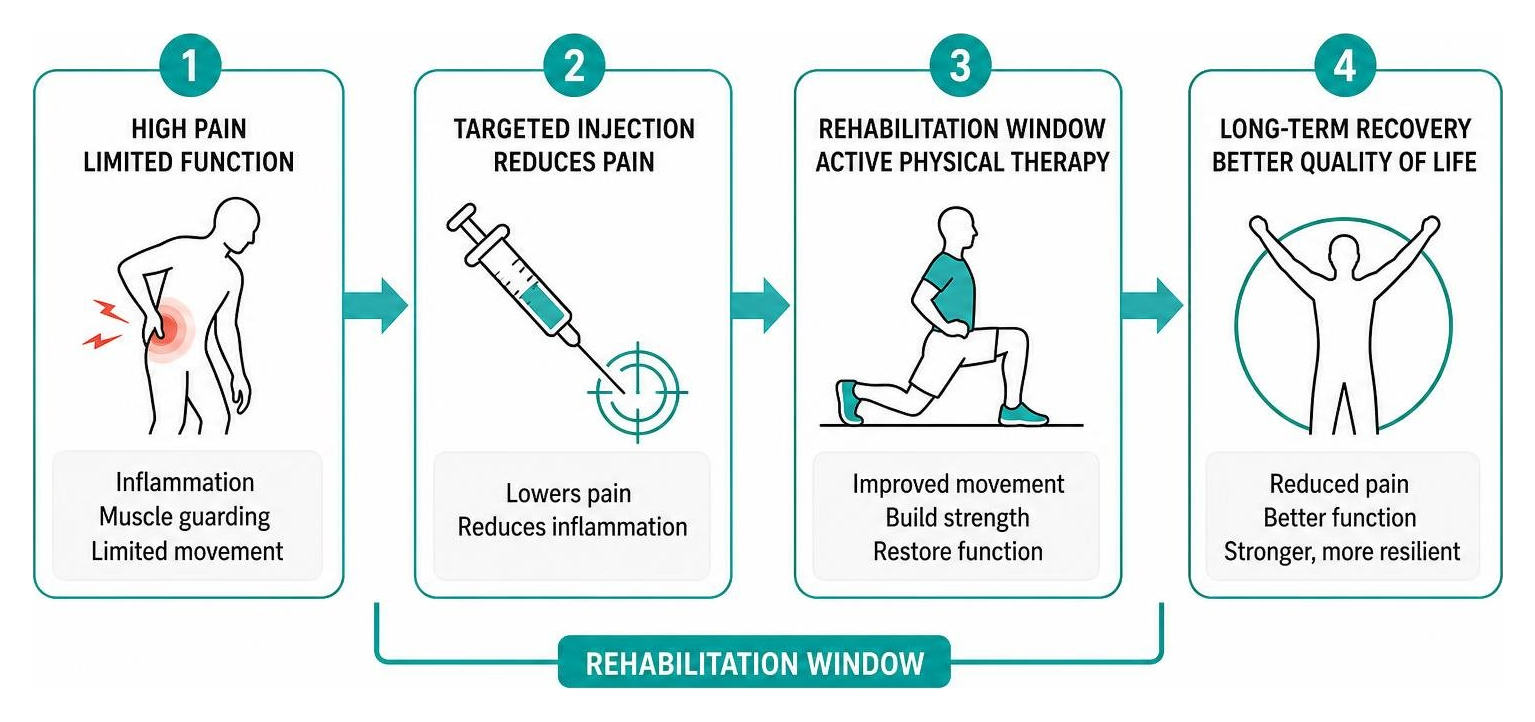
By administering targeted therapeutic injections, we temporarily lower your pain levels and reduce localized inflammation. This creates a comfortable, pain-free window during which you can actively participate in physical therapy, rebuild your strength, and restore your mobility. The injection clears the path, and the active rehabilitation builds the permanent solution.
Frequently Asked Questions about Interventional Pain Care
What are the potential risks and side effects of these procedures?
Because these procedures are minimally invasive and performed under precise imaging guidance, they have an exceptional safety profile. However, as with any medical procedure, there are minor risks to be aware of.
The most common side effects are temporary and mild, including soreness or bruising at the injection site, or a temporary increase in pain as the local anesthetic wears off and the steroid takes a few days to kick in.
To ensure the highest level of safety, we perform all procedures under strict aseptic (sterile) conditions to prevent infection. We also conduct a thorough review of your medical history, including any blood thinners or antiplatelet medications you may be taking, to minimize any risk of localized bleeding.
How long do the effects of interventional treatments typically last?
The duration of relief depends heavily on the specific procedure and your body’s unique healing response:
- Corticosteroid Injections (Epidurals & Facets): Typically provide relief lasting from three to six months, though some patients experience much longer relief when combined with physical therapy.
- Radiofrequency Ablation (RFA): Because it interrupts the nerve pathway, relief commonly lasts between six to twelve months (and up to 18 months for some individuals), depending on how quickly the tiny sensory nerves regenerate.
- Spinal Cord Stimulators: The lifespan of these devices depends on the specific model and whether it is rechargeable, but they typically provide continuous relief for two to more than ten years before requiring a simple battery replacement.
Does insurance typically cover interventional pain services?
Yes, the vast majority of interventional pain management procedures are covered by major health insurance plans, including Medicare, provided they are deemed medically necessary.
Because coverage criteria can vary from plan to plan, we highly recommend calling your insurance provider directly before your procedure. You should ask if pre-authorization is required for the specific procedure code recommended by your doctor, and verify your plan’s specific coverage details for outpatient interventional services. Our administrative team is always here to help you navigate this paperwork smoothly.
Conclusion
Living with chronic pain can make your world feel incredibly small, but you do not have to navigate this journey alone. At Global Pain & Spine Clinic in Niles, IL, we are proud to serve our neighbors across Northern Chicago — including Skokie, Glenview, Park Ridge, Morton Grove, Des Plaines, and Mount Prospect.
By combining the precision of advanced interventional pain management with the long-term healing power of physical therapy, chiropractic care, and regenerative medicine, we help you target pain at its source and reclaim your quality of life without relying on heavy medications.
If you are ready to take your first step toward lasting, non-surgical relief, we invite you to speak with our specialists. Explore our pain management ultimate guide to learn more and contact our clinic to schedule your comprehensive evaluation today. Let’s work together to help you live a full, active, and pain-free life!