






What Platelet-Rich Plasma Therapy Actually Is (And Why It’s Gaining Traction)
Platelet-rich plasma (PRP) therapy is a regenerative treatment that uses your own blood, concentrated with healing proteins, to support tissue repair, reduce pain, and improve function without surgery.
Here’s the quick version:
- What it is: Your blood is drawn, spun in a centrifuge, and the platelet-rich portion is injected back into the injured area
- How it helps: Platelets release growth factors that trigger your body’s natural healing response
- What it treats: Joint pain, tendon injuries, osteoarthritis, hair loss, and more
- How long it takes: The procedure takes about 30–60 minutes; results build over weeks to months
- How many sessions: Most patients need 1–3 injections, spaced several weeks apart
- Is it safe: It is generally well tolerated; because it uses your own blood, the risk of rejection or allergic reaction is very low
Think of it as giving your body a concentrated dose of its own repair signals — delivered exactly where healing is needed most.
For decades, people dealing with chronic pain, slow-healing injuries, or joint degeneration have had limited options: rest, pain medication, steroid injections, or surgery. PRP offers a different path. It doesn’t mask pain — it works with your biology to address the underlying damage.
Famous athletes like Tiger Woods and Rafael Nadal brought PRP into the public eye when they used it to recover from knee and tendon injuries. But today, it’s not just for elite sports — it’s a practical, evidence-backed option for everyday patients dealing with conditions like knee osteoarthritis, tennis elbow, and rotator cuff injuries.
Research supports its growing use. A meta-analysis of 30 randomized controlled trials involving over 3,400 patients found that PRP outperformed corticosteroids, hyaluronic acid, and placebo for knee osteoarthritis at 12 months — with benefits documented for up to 5 years in some patients.
I’m Anna Slavin, and at Global Pain & Spine Clinic I help patients across the Northern Chicago area — including Niles, Skokie, and Glenview — find lasting relief through innovative, non-surgical treatments like platelet-rich plasma (PRP) therapy. In this guide, I’ll walk you through everything you need to know to decide if it’s right for you.
What Is Platelet-Rich Plasma Therapy and How Does It Work?
To understand PRP therapy, we first have to look at what makes up your blood. Your blood is primarily a liquid called plasma, but it also contains solid components: red cells, white cells, and platelets. While platelets are famous for clotting blood, they are also the “first responders” to any injury. They are packed with hundreds of proteins called growth factors which are essential for healing.
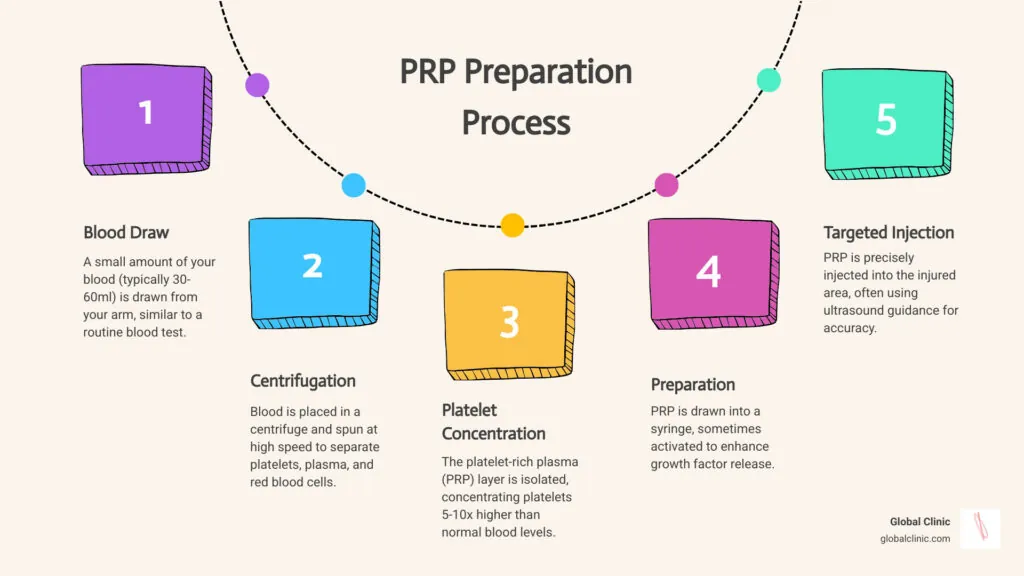
The process of preparing Platelet-Rich Plasma is relatively straightforward but requires precision. We begin by drawing a small amount of your blood, similar to a routine lab test. This sample is then placed into a specialized medical device called a centrifuge.
When the centrifuge spins at high speeds, it uses centrifugal force to separate the blood into distinct layers based on density. The red blood cells sink to the bottom, while the platelet rich plasma—now concentrated with 5 to 10 times the normal number of platelets—is gathered from the middle. By concentrating these platelets, we are essentially concentrating the “fuel” your body needs to rebuild itself. Once prepared, this “liquid gold” is injected directly into the site of your injury or pain.
The Biological Mechanism of PRP Therapy
Once injected, the platelets go to work immediately. They release bioactive proteins and signaling molecules called cytokines. These include Platelet-Derived Growth Factor (PDGF), Vascular Endothelial Growth Factor (VEGF), and Transforming Growth Factor-beta (TGF-beta).
These factors kickstart a sophisticated healing cascade:
- Inflammation Modulation: PRP helps transition a chronic, “stuck” injury into an active healing state.
- Neovascularization: VEGF stimulates the growth of new blood vessels, improving circulation to tissues like tendons that usually have poor blood flow.
- Collagen Synthesis: TGF-beta encourages the production of new collagen, the building block of our joints and connective tissues.
By unlocking healing with PRP injections, we are providing a biological “jumpstart” to areas that have failed to heal on their own.
Leukocyte-Rich vs. Leukocyte-Poor Formulations
Not all PRP is created equal. Depending on how we spin and process the blood, we can create different formulations. The main difference lies in the concentration of white blood cells, or leukocytes.
- Leukocyte-Rich (LR-PRP): Contains a higher concentration of white blood cells. This is often preferred for “tough” tissues like tendons (e.g., tennis elbow or patellar tendinitis) where a stronger inflammatory response is needed to break down scar tissue and restart healing.
- Leukocyte-Poor (LP-PRP): Has most white blood cells removed. This is typically the gold standard for joint issues like knee osteoarthritis, as it is gentler on the delicate lining of the joint.
Choosing the right formulation is an important part of PRP treatment, and the preparation is tailored to your specific injury.
Key Benefits of PRP Over Traditional Treatments
For many of our patients in the Chicago area, the biggest draw of PRP therapy is that it offers a middle ground between conservative care (like physical therapy) and invasive surgery.
| Feature | PRP Therapy | Corticosteroid Injections | Surgery |
|---|---|---|---|
| Primary Goal | Tissue Repair & Healing | Pain & Inflammation Masking | Structural Repair |
| Source | Your own blood (Autologous) | Synthetic chemicals | Invasive procedure |
| Downtime | Minimal (1-3 days) | Immediate return | Weeks to months |
| Longevity | Months to years | Short-term (weeks) | Permanent (ideally) |
| Side Effects | Very low | Tissue weakening over time | Infection, scarring, anesthesia risks |
Unlike steroids, which can actually weaken tendons and cartilage if used repeatedly, PRP supports the structural integrity of the tissue. It is a non-surgical alternative made from your own blood. This makes it a popular choice for joint relief through plasma injections for those who want to avoid the operating room.
Clinical Applications and Efficacy
PRP has moved from the “experimental” fringes into the mainstream of sports medicine and orthopedics. It is used to treat a wide range of musculoskeletal issues.
According to research on PRP for musculoskeletal injuries, the effectiveness of the treatment can vary based on the area being treated and the severity of the injury. However, results for some chronic conditions are encouraging.
Medical Conditions Treated with PRP Therapy
PRP is used for conditions such as:
- Knee Osteoarthritis: This is perhaps the most well-researched area. PRP has been shown to reduce pain and improve function for up to 12 months, often outperforming hyaluronic acid (gel shots).
- Tennis and Golfer’s Elbow: Chronic lateral epicondylitis often responds well to PRP, and some studies show better long-term results than with steroids.
- Rotator Cuff Tears: For partial tears, PRP can help bridge the gap and stimulate repair in the shoulder.
- Achilles Tendinopathy: Evidence for PRP in Achilles tendinopathy is mixed.
- Plantar Fasciitis: When stretching and orthotics aren’t enough, PRP can address the chronic inflammation in the foot.
Many patients find that PRP is a top choice for knee health because it addresses the biological environment of the joint, potentially slowing the progression of wear and tear.
The PRP Procedure: What to Expect
If you’ve never had a regenerative injection, you might be a little nervous. Don’t worry — we make the process as comfortable as possible at our clinic in Niles.
The entire visit usually takes about 30 to 45 minutes. Here is the step-by-step:
- Preparation: We recommend you stay well-hydrated for 24 hours before your appointment to make the blood draw easier.
- The Draw: We take a small amount of blood from your arm.
- Processing: Your blood is spun in the centrifuge for about 15 minutes.
- The Injection: We clean the target area and often use a local anesthetic to numb the skin. We then inject the concentrated PRP into the injured tissue.
When it comes to the ouch factor and what to expect pain-wise, most patients describe the sensation as a pressure or a dull ache. Because we are intentionally triggering a healing (inflammatory) response, you might feel a bit more sore for 24–48 hours after the injection. This is actually a good sign — it means the “repair crew” has arrived!
Recovery Timeline and Long-Term Results
Unlike a steroid shot, which might make you feel better by the time you walk out the door, PRP takes time. You are growing new tissue, and biology doesn’t happen overnight.
- Days 1-3: Expect some localized swelling and soreness. Ask your provider which pain relievers are appropriate; anti-inflammatories like ibuprofen are usually avoided because they may interfere with the healing response.
- Weeks 2-4: You may begin to notice a decrease in pain and a slight improvement in mobility.
- Months 3-6: This is the “sweet spot” where the most significant tissue repair occurs.
How long results last varies from person to person. In knee osteoarthritis studies, benefits have been recorded for several years in some patients.
Frequently Asked Questions about PRP Therapy
Who is a good candidate for PRP?
The best candidates are individuals with mild-to-moderate joint degeneration or chronic tendon injuries that haven’t responded to traditional care. Being a non-smoker and generally healthy helps, as your blood will have “healthier” platelets.
However, PRP is not for everyone. You should avoid this treatment if you have:
- Platelet dysfunction syndromes or low platelet counts
- Active systemic infections
- Certain types of cancer or blood disorders
- Advanced “bone-on-bone” arthritis (though PRP can still provide some symptomatic relief, expectations should be managed)
How many injections are typically needed?
While some patients see great results after a single session, most clinical protocols suggest a series of 1 to 3 injections. These are typically spaced about 4 to 6 weeks apart to allow the healing cascade to progress before adding more growth factors.
Is PRP therapy safe?
It is generally considered safe. Because PRP is autologous (meaning it comes from your own body), the risk of allergic reaction or rejection is low. The primary risks are the same as any needle-based procedure: minor bruising, temporary swelling, or a very rare risk of infection at the injection site. We maintain strict sterile protocols to keep these risks at an absolute minimum.
Conclusion
At Global Clinic, we believe that the best healthcare combines our team’s more than 20 years of clinical experience with the latest advancements in medical technology. Serving the Northern Chicago area—from Arlington Heights and Schaumburg to Niles and Skokie—we have seen how PRP therapy can help patients return to the activities they enjoy.
If you are tired of “managing” your pain with pills and are looking for a way to actually support your body’s healing process, we are here to help. Our multidisciplinary approach ensures that your PRP treatment is integrated into a comprehensive plan that might include physical therapy or chiropractic care for the best long-term results.
Don’t let chronic pain keep you on the sidelines. Reach out to our team of specialists to see if you are a candidate for this innovative treatment.
Call Global Pain & Spine Clinic at (847) 299-7000 or visit us at 8565 W. Dempster St. in Niles to schedule a PRP consultation.